Article Writing Class 12 – Free Format, Examples & Exam Tips
| Field | Detail |
|---|---|
| Writing Skill Topic | Article Writing |
| Subject | English Core / English Elective |
| Class | 12 (also applicable to Class 11) |
| Board | CBSE |
| Exam Relevance | Direct — Very Long Answer Type question |
| Difficulty | Moderate |
| Common in Exam | Yes — 5-mark question, one of two choices |
Article writing is the one question in your Class 12 CBSE English paper where you get to think, argue, and write in your own voice — and it carries a full 5 marks that students either nail completely or lose mostly due to structural errors. The task tests far more than vocabulary; it evaluates whether you can organise a clear argument, open with purpose, sustain a logical flow through body paragraphs, and land a conclusion that leaves an impression.
This question appears as a Very Long Answer Type question in Section B of the Class 12 English Core paper, carrying 5 marks with a 120–150 word limit. You will get two questions with an internal choice and must attempt one. It is also closely linked to debate writing and speech writing, all three following overlapping structural principles — so mastering this format helps you across multiple exam questions.
Consider this: in your Hindi class, your teacher probably told you “antim pankti yad rehni chahiye” — the last line should stay with the reader. That same logic applies here. A Class 12 article that ends with a sharp, purposeful conclusion — not a trailing “therefore, in conclusion, we should all…” — is what separates a 4-mark answer from a 5-mark one. These notes will show you exactly where those marks go and how to earn each one.
What’s in These Notes?
- What is Article Writing?
- Article Writing Format for Class 12 CBSE
- Rules for Each Section of Your Article
- The Marking Scheme: How Examiners Award 5 Marks
- Common Mistakes Students Make in Article Writing
- Article Writing Examples: Annotated Sample Articles
- Practice Exercises – Article Writing Class 12
- Important Questions – Article Writing Class 12
- FAQ – Article Writing Class 12
- Quick Revision – Key Rules to Remember
- Explore More English Writing Skills on Nextoper
- Trusted Resources for Deeper Study
What is Article Writing?
An article is a piece of formal writing published in a newspaper, magazine, journal, or online platform for the purpose of informing, persuading, or entertaining a specific audience on a chosen topic. Unlike a letter or a report, an article is meant for a general readership, which means the writer must make the content accessible, engaging, and coherent without relying on a pre-established personal relationship with the reader.
In the CBSE Class 12 examination, article writing tests your ability to do three things simultaneously: present factual or opinion-based content on a given topic, organise that content into a logical structure (introduction → body → conclusion), and express it in language that is accurate, fluent, and appropriately formal. These are not three separate tasks — they must work together in a single, unified piece of writing within 120–150 words.
The article differs from an essay in one important way: it is always written for publication. This means it carries a title, a byline (author’s name), and must consider its audience actively. An essay written for personal analysis can afford to be inward-looking; an article cannot. It must address, engage, and, where appropriate, persuade its reader from the first line to the last.
📷 [Image: Diagram showing the three core purposes of article writing — Inform / Persuade / Entertain — with arrows leading to a central box labelled “Published Article”] [Alt text: article writing class 12 – three purposes of an article diagram]
Article Writing Format for Class 12 CBSE
The format of an article in CBSE Class 12 consists of three essential components: the title, the byline, and the body. These three elements are non-negotiable for format marks — missing any one of them will cost you the 1 mark allotted to format in the marking scheme.
Component 1: The Title (Heading)
The title should be catchy, concise, and clearly indicate the topic. It must not exceed 5–6 words. Avoid dull, generic titles like “Article on Pollution” — these signal to an examiner that the student defaulted to the obvious. Strong titles often use contrast, a rhetorical question, or a striking phrase.
| Weak Title ✗ | Strong Title ✓ |
|---|---|
| Article on Pollution | Breathing Poison: India’s Urban Air Crisis |
| Importance of Education | Education: The Investment That Never Depreciates |
| Social Media and Youth | Scrolling Away: What Social Media Costs Our Generation |
The title is written at the top, usually centred, and does not need to be underlined (though some students do underline it — that is acceptable in CBSE).
Component 2: The Byline
The byline is the author’s name. It appears directly below the title, typically in the format “By [Name].” In exams, CBSE explicitly states: use the name given in the question. If the question says “You are Arjun Mehta,” write “By Arjun Mehta.” If no name is given, use a general fictitious Indian name (e.g., By Priya Sharma). You must never write your own real name or roll number — CBSE’s anonymity rules apply.
Component 3: The Body
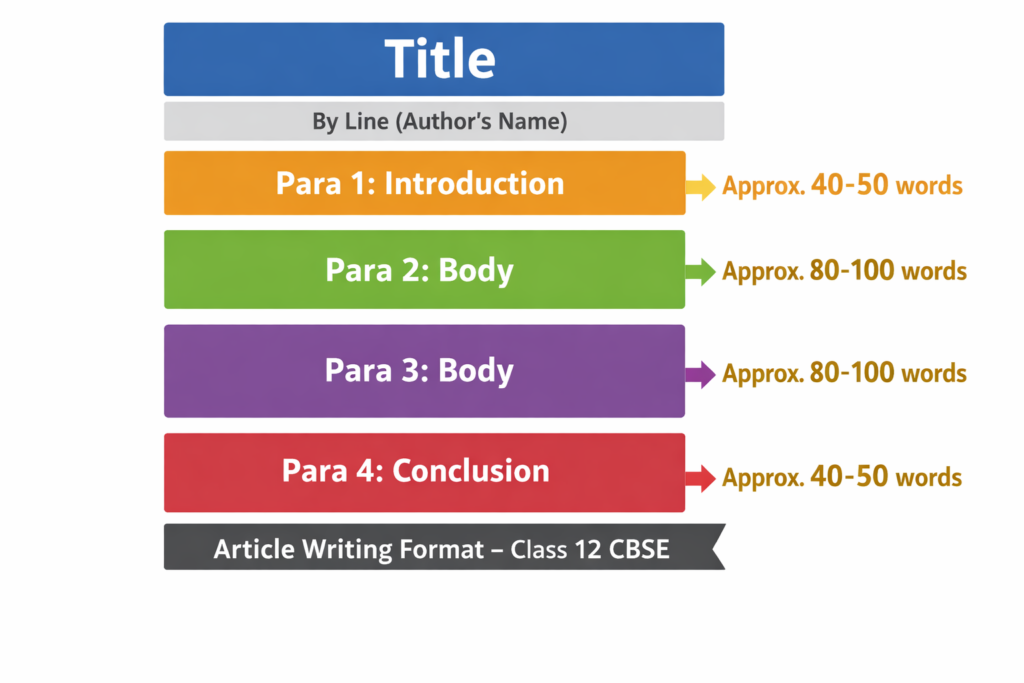
The body of a Class 12 article should consist of 3 to 4 paragraphs:
- Paragraph 1 — Introduction: Introduce the topic with a hook (a question, a striking fact, a short anecdote, or a powerful statement). Establish what the article is about and why it matters.
- Paragraph 2 — Body (Causes/Arguments/Analysis): Develop the main argument. Present facts, examples, and logical reasoning. This is where most of your content marks are earned.
- Paragraph 3 — Body (Effects/Solutions/Counterpoint): Add depth by expanding on effects, solutions, or a well-considered counterpoint. For social topics, this paragraph usually moves from “problem” to “solution.”
- Paragraph 4 — Conclusion: Keep it short and punchy. Summarise your core argument, offer a recommendation, or end with a thought-provoking question or call to action. Never leave it open-ended.
Rules for Each Section of Your Article
Understanding the format is one thing; knowing the specific writing rules for each section is what earns marks on the expression criteria. Below are the rules every Class 12 student must follow.
Rules for the Introduction
- Open with a hook: a rhetorical question, a surprising statistic, a short real-world scenario, or a relevant quote. This signals to the examiner that you understand audience engagement.
- The introduction should be 2–3 sentences — do not exceed 30–35 words in a 120–150 word article.
- State the topic clearly within the introduction. The examiner should know what the article is about after reading the first paragraph.
- Avoid these openers (they signal a student who hasn’t thought about the writing): “Nowadays,” “In today’s world,” “It is a well-known fact that,” “Since time immemorial.”
Rules for the Body Paragraphs
- Each body paragraph must focus on one main idea. Starting a new idea mid-paragraph is a common structural error.
- Use linking devices to connect sentences and paragraphs: however, therefore, consequently, in contrast, moreover, as a result, in addition, despite this.
- Support your arguments with facts, examples, or logical reasoning. In the exam, you may use approximate statistics (“studies show,” “experts suggest”) — you are not expected to have memorised exact data.
- Use passive voice strategically for formal distance: “It has been observed that…” rather than “I think…”
- Avoid first-person references (“I believe,” “In my opinion”) unless the article prompt clearly invites a personal perspective. Most CBSE article topics are third-person or second-person in tone.
Rules for the Conclusion
- The conclusion must not introduce a new idea. Its only job is to synthesise what was said and close the loop.
- End with either: a recommendation (“The government must…”), a call to action (“It is time for each of us to…”), or a thought-provoking closing statement.
- Keep it to 2–3 sentences maximum.
- A weak conclusion is one that simply repeats the introduction. A strong conclusion is one that feels like the natural endpoint of an argument — the reader knows the writer meant to stop exactly there.
The Marking Scheme: How Examiners Award 5 Marks
[CONTENT GAP FILL] This is the section no competitor explains in student-friendly terms, yet it is arguably the most exam-relevant information on this page.
CBSE article writing for Class 12 carries 5 marks distributed across four criteria:
| Criteria | Marks | What Examiners Look For |
|---|---|---|
| Format | 1 mark | Title present, byline present, three-part structure (intro + body + conclusion) followed |
| Content | 2 marks | Relevant ideas, logical organisation, adequate depth for the topic, no factual irrelevance |
| Expression — Accuracy | 1 mark | Correct grammar, spelling, punctuation throughout |
| Expression — Fluency | 1 mark | Natural sentence flow, varied sentence length, appropriate vocabulary, use of linking devices |
This breakdown tells you something critical: format is the easiest mark to score, and content is the heaviest. A student who follows the heading-byline-body structure will not lose that format mark. But to get both content marks, your article must have clearly developed ideas with supporting detail — not just three vague paragraphs that restate the same point in different words.
The expression marks (accuracy + fluency) together equal the same weight as content. This means grammar and sentence variety are just as important as ideas. A beautifully structured argument written with consistent subject-verb agreement errors will lose the accuracy mark. And paragraphs made entirely of short, choppy sentences will lose the fluency mark even if the content is strong.
The 5/5 formula: Follow format (1 mark) + develop 2–3 strong, relevant ideas with examples (2 marks) + write accurately with varied sentence structure and linking devices (2 marks).
Common Mistakes Students Make in Article Writing
[CONTENT GAP FILL] Below are the six most common structural and language errors in Class 12 article writing, shown as wrong → corrected examples.
| Mistake | Wrong ✗ | Correct ✓ |
|---|---|---|
| Vague title | Pollution Article | Silent Killer: The Price of Unchecked Air Pollution |
| Writing your own name in byline | By [Student’s Real Name / Roll No.] | By Meera Kapoor (use name from question or a fictitious name) |
| Repeating intro in conclusion | “Thus, pollution is a major problem and we should take steps to reduce it.” (same as intro) | “The time for awareness campaigns alone has passed — regulation, technology, and individual accountability must now work in tandem.” |
| No linking devices | “Pollution causes diseases. Children are affected. Government should act.” | “Pollution causes diseases; children, in particular, suffer the most. Consequently, the government must prioritise clean-air legislation.” |
| Exceeding word limit | Writing 200+ words when limit is 120–150 | Plan before writing: 25–30 words intro, 70–80 words body, 20–25 words conclusion = ~120–130 words |
| Using first person excessively | “I think we should all recycle. I feel the government is responsible. In my opinion…” | “Recycling must become a civic habit, not a personal choice. The government bears responsibility for making infrastructure available.” |
Article Writing Examples: Annotated Sample Articles
[CONTENT GAP FILL] Below are two complete sample articles on the same topic — one scoring approximately 3/5 and one scoring 5/5. Examiner comments are in brackets to show exactly where marks are earned or lost. This is the differentiated content no competitor offers.
Question: Write an article in 120–150 words for your school magazine on The Impact of Social Media on Teenagers. You are Ravi Shankar.
Sample A — Approx. 3/5 (Read the examiner notes)
Social Media Is Bad For Teenagers By Ravi Shankar
[Format mark: ✓ Title and byline present. Structure present.]
Social media is very popular nowadays. Teenagers use it a lot. [Content: ✗ Weak hook; no engaging opening. “Nowadays” is a clichéd opener.]
Teenagers spend hours on Instagram and Facebook. This affects their studies. They also don’t sleep properly. Mental health problems are increasing. Cyberbullying is also a problem. [Content: Partially ✓. Ideas are present but underdeveloped; no examples or data; all sentences are short and choppy — fluency mark at risk.]
So teenagers should use social media less. Parents and teachers should guide them. [Conclusion: ✗ Too brief; no recommendation with reasoning; just repeats that it is bad.]
Examiner’s Note: Format ✓ (1/1), Content: 1/2 (ideas present but undeveloped), Accuracy: 1/1 (grammatically correct), Fluency: 0/1 (all short choppy sentences, no linking devices, no vocabulary variety). Total: 3/5.
Sample B — 5/5 (Study this structure)
Scrolling Away: What Social Media Costs Our Generation By Ravi Shankar
[Format mark: ✓ Catchy title with contrast device; byline correctly placed.]
A teenager today spends an average of five hours daily on social media — time once invested in reading, sport, or simply growing up. [Hook: ✓ Specific, striking statistic as opener; not generic.]
While platforms like Instagram and YouTube offer genuine value — connecting communities, sparking creativity — their addictive design prioritises engagement over wellbeing. Teenagers in the grip of endless scrolling report disturbed sleep, reduced attention spans, and heightened anxiety. Cyberbullying, too, has moved from playground to phone screen, following its victims home. [Body: ✓ Two-sided analysis, specific effects, linking device “While,” formal vocabulary — “addictive design,” “heightened anxiety.”]
Responsible use, not complete avoidance, is the realistic goal. Digital literacy programmes in schools, combined with parental awareness, can equip teenagers to use these tools without being used by them. [Conclusion: ✓ Clear recommendation with reasoning; no new ideas introduced; strong final sentence.]
Examiner’s Note: Format ✓ (1/1), Content ✓ (2/2 — well-developed, two-sided, specific), Accuracy ✓ (1/1), Fluency ✓ (1/1 — varied sentence length, linking devices, strong vocabulary). Total: 5/5.
Practice Exercises – Article Writing Class 12
(This section contains three exercise sets based on common CBSE question types.)
SET A — Write the Article ★ / ★★ / ★★★
Instructions: Write an article in 120–150 words for each of the following prompts. Use the correct CBSE format: title, byline, and three-paragraph body.
- ★ You are Priya Mehta. Write an article for your school magazine on The Importance of Reading Books in the Age of Smartphones.
- ★ You are Arjun Verma. Write an article for The Lucknow Herald on How Cleanliness Drives Impact a City’s Image.
- ★★ You are Meera Joshi. Write an article for a national youth magazine on Should Competitive Exams Like JEE and NEET Be Replaced?
- ★★ You are Ravi Patel. Write an article on The Role of Women in Modern India’s Workforce for a state-level seminar publication.
- ★★ You are Sunita Agarwal. Write an article for your school newsletter on Online Classes vs Offline Classes — What Truly Works for Students.
- ★★★ You are Kiran Sharma. Write an article for The Patna Times arguing that Climate Change Is India’s Most Urgent Priority Over Economic Growth.
- ★★★ You are Deepak Nair. Write an article on The Digital Divide: Why Better Internet Access Alone Will Not Fix India’s Education Gap.
- ★ You are Ananya Singh. Write an article for a Jaipur student magazine on Yoga and Mental Health — A Lesson Modern Schools Are Missing.
- ★★ You are Rahul Gupta. Write an article arguing that Street Food Vendors Are India’s Unsung Cultural Ambassadors.
- ★★★ You are Neha Agarwal. Write an article for a national publication on The Ethics of Artificial Intelligence: Who Is Responsible When Machines Make Mistakes?
Model Answer for Q1:
Books in a World of Screens By Priya Mehta
In an era where a teenager’s world fits inside a five-inch screen, the habit of reading a physical book has become almost countercultural. Yet it remains one of the most powerful tools for building vocabulary, concentration, and empathy — qualities no algorithm can replicate.
Smartphones deliver information in fragments: short videos, reels, and headlines. Books demand sustained attention and reward it with depth. Research consistently shows that regular readers develop superior critical thinking skills and emotional intelligence. Students who read for pleasure also outperform their peers in written expression — an advantage that shows directly in board exams.
Reading and smartphones need not compete. Fifteen minutes with a book before bed costs nothing and delivers what no notification can: quiet, focused, genuinely personal time. The screen will always be there; the habit of reading must be actively protected.
SET B — Error Identification and Correction ★★
Instructions: Each sentence below contains an error related to article writing format or language. Identify the error and rewrite the sentence correctly.
- The title of the article was written as: “An Article About The Negative Effects Of Junk Food On Health Of Students.”
- The byline read: “By Roll No. 23, Section A.”
- The student began the article: “In today’s modern world, pollution is a very big problem nowadays.”
- The conclusion of the article said: “Therefore, just as I mentioned in the beginning, we should take care of the environment.”
- Every body paragraph began with “Firstly… Secondly… Thirdly…” and no other transition was used throughout.
Answers — SET B:
- Error: Title is too long (11 words) and mechanical. Correction: “Junk Food: The Hidden Cost of Our Daily Choices” (7 words, engaging).
- Error: Byline must use a name, never a roll number. Correction: “By Arjun Mehta” or whichever name the question provides.
- Error: “In today’s modern world” and “nowadays” are both clichés; “modern” and “today’s” are redundant. Correction: “Pollution now ranks among the most urgent public health crises facing urban India.”
- Error: The conclusion introduces no new direction and simply repeats the introduction. Correction: “Every individual decision — to cycle instead of drive, to plant instead of pave — is a vote cast for a liveable future.”
- Error: Overuse of basic listing transitions creates choppy, unvaried flow and loses fluency marks. Correction: Vary transitions — use moreover, however, consequently, despite this, as a result — to show logical rather than sequential thinking.
SET C — Improve the Weak Article ★★★
Instructions: Below is a poorly written article that would score approximately 2/5. Rewrite it to score 5/5. Keep the same topic; improve the title, byline placement, language quality, use of linking devices, and conclusion.
Original (Score: ~2/5):
Article On Deforestation By Me
Deforestation is very bad. Trees are cut down. Animals lose their homes. Also there is global warming. Carbon dioxide is increasing.
People should stop cutting trees. Government should make laws. We should all plant trees. Then everything will be better.
Model Rewrite (Score: 5/5):
When the Last Tree Falls, It Takes Everything With It By Meera Joshi
Every two seconds, a forest the size of a football field disappears from the earth’s surface. Deforestation — driven by agricultural expansion, urban sprawl, and commercial logging — has quietly become one of the defining crises of our generation.
The consequences extend far beyond the loss of trees. Entire ecosystems collapse: animals lose habitat, soil erodes, water tables drop, and carbon stored for centuries is released into an already warming atmosphere. Indigenous communities who depend on forests for livelihood lose not just income but identity. In a country like India, where monsoon patterns are intrinsically linked to forest cover, the stakes are existential.
Governments must enforce forest protection laws without exception. Simultaneously, individuals and corporations alike must invest in reforestation — not as charity, but as survival. The trees we plant today are the lungs of the world our children will inherit.
Important Questions – Article Writing Class 12
1 Mark — Define
Q: What is the byline in an article, and what rule applies to it in CBSE board exams?
A: The byline is the name of the author, placed directly below the title of the article; in CBSE board exams, students must use the name provided in the question, or a fictitious name if none is given, and must never write their own personal details.
3 Marks — Explain with Examples
Q: Explain the purpose of the introduction in an article and describe two effective techniques for writing a strong opening.
A: The introduction in an article serves to hook the reader’s attention and establish the topic clearly within the first 2–3 sentences. Since the examiner reads dozens of articles on the same prompt, a strong opening distinguishes a thoughtful writer from one who defaulted to a predictable structure.
Two effective techniques are: first, opening with a striking statistic or fact — for example, “India loses approximately 1.5 million hectares of forest cover every year” immediately grounds the article in reality and signals research. Second, opening with a rhetorical question — “Have we ever stopped to ask who really pays the price for our consumption habits?” — draws the reader in by making them personally implicated in the topic. Both techniques work because they create forward momentum; the reader wants to continue.
Q: What are the four criteria on which a Class 12 article is evaluated, and how should a student approach each to score full marks?
A: CBSE evaluates article writing across four criteria worth a total of 5 marks. First, Format (1 mark): the student must include a title, a byline, and a three-part body structure — missing any element loses this mark. Second, Content (2 marks): the article must present 2–3 developed ideas with relevant examples; vague, repetitive, or off-topic content will lose marks here. Third, Accuracy (1 mark): correct grammar, spelling, and punctuation throughout; a single sentence with correct structure is worth more than three grammatically confused ones. Fourth, Fluency (1 mark): natural sentence flow, varied sentence length, and appropriate use of linking devices like however, consequently, moreover, despite this. A student who consciously addresses all four criteria — not just content — has a clear path to 5/5.
5 Marks — Full Explanation
Q: Explain the format and writing process for an article in Class 12 CBSE English. Include the purpose of each component, the marking criteria, and two common mistakes students must avoid.
A: An article in Class 12 CBSE English is a 120–150 word piece of formal writing structured around three essential components: the title, the byline, and the body. The title must be concise (5–6 words), catchy, and clearly signal the topic — it earns the reader’s attention and contributes to the 1-mark format criterion. The byline is the author’s name, placed below the title; students must use the name provided in the question or a fictitious name, never their own personal details.
The body consists of three to four paragraphs. The introduction opens with a hook — a question, statistic, or scenario — and establishes the topic. The body paragraphs develop the main ideas with examples, facts, and logical reasoning, connected by linking devices such as however, consequently, and as a result. The conclusion synthesises the argument and ends with a recommendation or thought-provoking statement, without introducing new ideas.
CBSE awards marks for format (1), content (2), accuracy (1), and fluency (1). Two mistakes students must avoid: first, a weak conclusion that simply restates the introduction loses both the fluency mark and part of the content mark. Second, using choppy, same-length sentences throughout — even with correct grammar — loses the fluency mark because varied sentence structure signals genuine writing ability.
Q: Compare a weak article (scoring approximately 2–3 out of 5) with a strong article (scoring 5 out of 5) on a common CBSE topic. Identify the specific differences that account for the difference in marks.
A: The most instructive way to understand article writing quality is to compare two responses on the same topic. A weak article on, for example, “The Importance of Physical Education in Schools” typically exhibits these features: a generic title (“Article on Physical Education”), an opening like “Nowadays, physical education is very important,” underdeveloped body paragraphs that list points without explanation (“It keeps students healthy. It teaches teamwork. It reduces stress.”), and a conclusion that merely echoes the introduction.
A strong article on the same topic opens with engagement: “In schools where the bell rings only for academic periods, students are learning everything except how to be well.” The body develops two or three specific ideas — the link between physical activity and cognitive performance, the mental health benefits of structured sport, the long-term habit formation that PE enables — using linking devices and varied sentence structures. The conclusion offers a clear recommendation: “Physical education is not a luxury in the curriculum; it is a foundation. No school that removes it can claim to educate the whole child.”
The differences are concrete: title quality, introduction technique, depth of development, use of transitions, sentence variety, and purposeful conclusion. Each difference maps directly onto the four marking criteria — and together, they account for the full 2–3 mark gap between a mediocre and an excellent response.
FAQ – Article Writing Class 12
Q: What’s the difference between an article and an essay in Class 12 English? A: An essay is typically written as an extended personal or academic exploration without a byline or publication context; an article is written for publication and always includes a title and byline. In CBSE exams, article writing tests audience-awareness — your tone should speak to a newspaper or magazine reader, not to an examiner reading your personal thoughts. An essay can afford to be reflective; an article must be direct and engaging from line one.
Q: Can I use my real name in the byline during the CBSE board exam? A: No — and this is a specific CBSE rule. You must never write your own name or roll number in any answer, including the article byline. Use the name given in the question. If the question says “You are Priya,” write “By Priya” or “By Priya Sharma.” If no name is provided, invent a believable Indian name. Your own identity must never appear in your answer booklet.
Q: What’s the difference between a good article title and a weak one — and does it actually affect marks? A: Yes, it affects both the format mark and the fluency mark. A weak title like “Article on Pollution” tells the examiner nothing new. A strong title like “Breathing Poison: India’s Urban Air Crisis” shows vocabulary range, signals purpose, and hooks the reader in 6 words. CBSE’s marking guidelines reward expression quality — and a well-crafted title is the first expression the examiner sees. Five seconds of thought on your title can be worth more than five minutes of extra content.
Q: Why do I lose marks even when my grammar is correct? A: Because CBSE splits expression into two separate marks — accuracy and fluency. You can write grammatically correct sentences and still lose the fluency mark if all your sentences are the same short length, if you use the same transitions repeatedly (“firstly… secondly… thirdly…”), or if your vocabulary is flat and monotonous. Fluency rewards natural flow, sentence variety, and the kind of language that feels like a thinking person wrote it — not a list reader.
Q: How do I manage time for article writing in the exam — how long should I spend on it? A: Article writing carries 5 marks in a paper where time is precious. Allocate your 25 minutes like this: 5 minutes to read the prompt, choose your topic (if there’s internal choice), and jot down 3–4 key points + your title; 15 minutes to write the article — introduction first (2–3 sentences), body (two clear paragraphs with 2 points each), conclusion (2 sentences); 5 minutes to re-read for spelling, grammar errors, and to confirm your word count is within 120–150 words. Students who skip the planning phase consistently write articles that run over 200 words or lose focus midway — both of which cost marks.
Quick Revision – Key Rules to Remember
- Article writing in CBSE Class 12 is a 5-mark Very Long Answer Type question with a word limit of 120–150 words, tested in Section B of the English Core paper.
- Every article must have three visible components: a title (5–6 words, catchy), a byline (the name from the question or a fictitious name), and a structured body of 3–4 paragraphs.
- CBSE marks are distributed across four criteria: Format (1), Content (2), Accuracy (1), and Fluency (1) — failing to address all four is how students score 3/5 instead of 5/5.
- The introduction must open with a hook — a rhetorical question, a striking statistic, a short anecdote, or a powerful statement — never a clichéd phrase like “Nowadays” or “In today’s world.”
- Each body paragraph must address one idea only; introducing multiple unconnected points in a single paragraph costs both content and fluency marks.
- Linking devices are non-negotiable for the fluency mark: use however, consequently, moreover, despite this, as a result, in contrast to show logical connections between ideas.
- The conclusion must not introduce a new idea; it must synthesise the argument and close with a recommendation, a call to action, or a thought-provoking statement.
- Using your own name or roll number in the byline is a CBSE rule violation; always use the name given in the question or a fictitious name.
- A title that is too long (more than 6 words) or too generic signals poor writing quality — invest 30 seconds in crafting a title that is specific, engaging, and vocabulary-rich.
- In the exam hall, follow the 5-15-5 rule: 5 minutes planning, 15 minutes writing, 5 minutes reviewing — students who skip planning routinely exceed the word limit and lose structure midway.