Last Updated: 16 September 2026 | CBSE Session 2025-26 | Reviewed by Nextoper Editorial Team
CBSE Class 9 English Chapter 9 PDF Notes The Snake Trying 2025-26
If you’re revising Class 9 English Chapter 9 PDF notes, The Snake Trying, this page gives you everything in one place. You get the full summary, the poet’s message, poetic devices, MCQs, PYQs, and a quick-revision block you can scan in two minutes.
This poem sits in your Beehive textbook. It’s short, but examiners still pick tricky questions from it. Read this once carefully, and you won’t need to open five different tabs before your exam.
👉 Download the free PDF of NCERT Solutions for The Snake Trying at the end of this page.
Table of Contents
- About the Poem and the Poet
- Summary of The Snake Trying
- The Snake and the Man: A Closer Look
- Themes and Central Message
- Poetic Devices Used
- Word Meanings (Glossary)
- NCERT Textbook Questions and Answers
- MCQs for Practice
- 60-Second Quick Revision
- Previous Years’ Questions (PYQs)
- One-Line Answer for Quick Lookup
- Frequently Asked Questions
Chapter Overview: About the Poem and the Poet
The Snake Trying is written by W.W.E. Ross, a Canadian poet. He is often called the first modern Canadian poet because he was among the earliest in Canada to write in the Imagist style. Imagist poets keep their lines short. They avoid heavy rhyme. They focus on one clear picture instead of long descriptions.
Ross trained as a geophysicist, which means he studied the physical structure of the earth. That background shows up in his poetry. He notices small, precise details in nature the way a scientist would, then turns them into something emotional.
This poem has no fixed rhyme scheme. It reads more like a quick, urgent thought than a structured verse. That style matches the subject: a snake in sudden danger, trying to get away in seconds.
You’ll find this poem in the Beehive textbook for Class 9 English, prescribed by CBSE for the 2025-26 session. It’s short — around 16 lines — but don’t let the length fool you. Board papers have picked value-based and long-answer questions from this exact poem in past years, so understanding the “why” behind each line matters more than memorising it.
Get free Class 9 English Chapter 9 PDF Notes
Summary of The Snake Trying
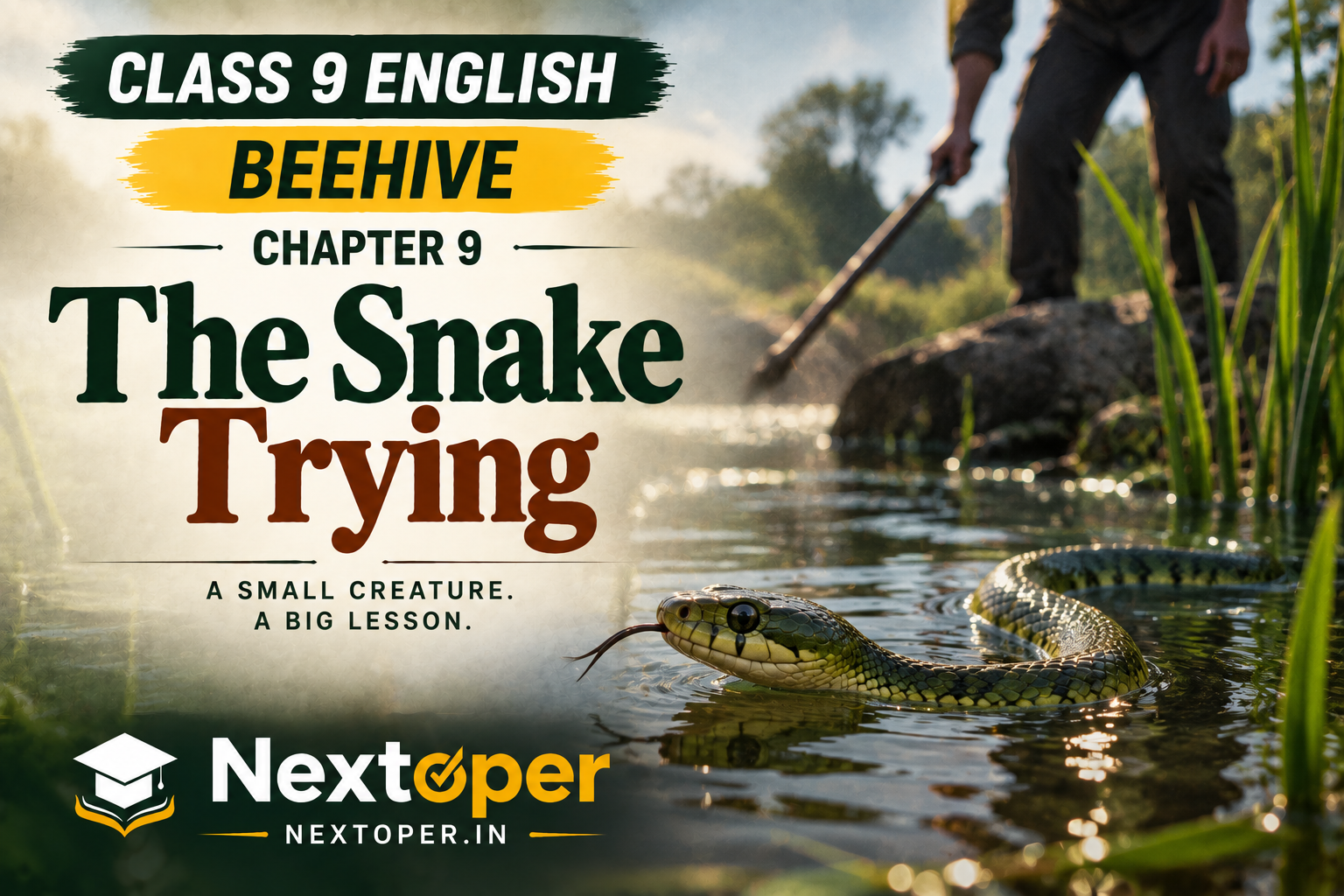
Picture this scene. A snake is resting quietly near water, doing nothing to anyone. A man spots it. Without checking whether it is dangerous, he assumes the worst and grabs a stick to kill it.
The snake senses the threat immediately. It has no weapon, no way to fight back — only speed and instinct. So it does what any frightened creature would do. It moves fast, bending and curving its body, sliding through the water to put distance between itself and the stick.
Here’s where the poem shifts from action to feeling. The speaker isn’t scared of the snake. He’s watching it the way you’d watch something rare and lovely — admiring how smoothly it turns and glides, how small and green it looks against the water. To him, the snake’s movement is closer to art than to threat.
That admiration turns into a plea. The speaker silently hopes the man will stop chasing it. He wants the snake to be let go rather than struck down, because he can see clearly what the man refuses to see: this creature has done nothing wrong.
The poem doesn’t tell you whether the man listens. What you do know is the ending — the snake reaches the reeds at the water’s edge and disappears among them, escaping just in time.
That’s the entire poem in a single scene: fear on one side, cruelty born from that fear on the other, and a quiet, sympathetic observer caught in between, hoping kindness wins.
The Snake and the Man: A Closer Look
This poem doesn’t have “characters” in the way a story does. Instead, it works through two contrasting figures and one observing voice. Understanding what each one represents is exactly what long-answer questions test.
The Snake stands for every creature that gets judged unfairly because of how it looks. It is small, green, and — this is the detail examiners love to test — not dangerous at all. It never attacks. It only tries to survive. Its entire presence in the poem is defensive: resting, sensing danger, fleeing, hiding. Nothing in its behaviour suggests aggression.
The Man with the stick represents a very human habit: reacting to fear with violence instead of checking the facts first. He doesn’t pause to ask if the snake is actually poisonous. He assumes danger and acts on that assumption. In that sense, he’s not really evil — he’s careless, and carelessness born from fear can be just as harmful as intentional cruelty.
The Speaker/Poet is the moral center of the poem. He notices what the man doesn’t: that the snake is beautiful, harmless, and terrified. His silent appeal — please let it go — is the poem’s real point. He isn’t just describing a scene; he’s asking you, the reader, to look twice before judging any creature by its reputation.
Exam tip: If a question asks you to compare the man and the poet’s attitude, don’t just say “one is bad, one is good.” Explain that the contrast is between acting out of unchecked fear versus acting out of observation and empathy. That distinction earns full marks in a 3-mark or 5-mark answer.
Themes and Central Message
1. Compassion for animals. The poem’s core message is simple: don’t harm a creature just because it looks unfamiliar or unsettling. Fear is not proof of danger.
2. Human cruelty rooted in ignorance. The man’s decision to kill isn’t based on evidence — it’s based on assumption. The poem quietly criticises this pattern, one that still shows up today whenever people harm snakes, spiders, or bats out of instinctive fear rather than fact.
3. Beauty exists even in creatures we fear. The poet finds grace in the snake’s movement. This pushes you to separate how something looks or is perceived from what it actually is.
4. Survival instinct. The snake’s flight isn’t cowardice — it’s the most natural response any living being has to a real threat. The poem treats this instinct with respect, not judgement.
If you remember just one line for your answers: this poem argues that empathy should come before fear-driven action — every time.
Poetic Devices Used in The Snake Trying
You don’t need to memorise definitions — you need to spot these in the poem and explain their effect.
- Imagery: The poet builds a clear mental picture of the snake’s colour, size, and movement, so you can “see” the scene rather than just read about it.
- Free verse: No fixed rhyme or meter. The irregular, short lines mirror the sudden, urgent movement of a creature trying to escape.
- Alliteration: Ross repeats consonant sounds at points in the poem to create rhythm without relying on rhyme — this is common in Imagist poetry.
- Slant (near) rhyme: A few line-endings echo each other loosely rather than rhyming exactly, keeping the poem’s tone conversational instead of sing-song.
- Symbolism: The snake symbolises every misunderstood or feared creature; the man symbolises reactive, unexamined fear.
Word Meanings (Glossary)
| Word/Phrase | Simple Meaning |
|---|---|
| Pursuing | Chasing after something |
| Beautiful and graceful | Elegant, pleasing to look at in its movement |
| Curves/curving | Bending its body into smooth, wave-like shapes |
| Glides | Moves smoothly and silently, without effort |
| Ripples | Small waves on the surface of water |
| Reeds | Tall, thin plants that grow near water |
| Escaping | Getting away from danger |
(Table kept to two columns for mobile readability — swipe if viewing on a small screen.)
NCERT Textbook Questions and Answers
Q1. What is the snake trying to escape from? It is trying to get away from a man chasing it with a stick. The man assumes it’s dangerous, even though it never threatened anyone.
Q2. Is it a harmful snake? What is its colour? No. It’s a small, green, harmless snake. Its colour and size are part of why the poet finds it gentle rather than frightening.
Q3. Find the words the poet uses to show the snake’s beauty. The poet describes it as graceful in its movement, praises how it glides through the water, and highlights its small size and green colour — all details that build a picture of quiet elegance rather than threat.
Q4. What does the poet wish for the snake? He wants the man to stop chasing it and let it live. He hopes cruelty gives way to mercy before it’s too late.
Q5. Where was the snake before it was chased, and where does it disappear? Before the chase began, it was resting peacefully near the water’s edge. Once threatened, it flees and vanishes among the reeds growing by the water.
MCQs for Practice
1. Who wrote The Snake Trying? a) Robert Frost b) W.W.E. Ross c) Walt Whitman d) D.H. Lawrence
2. Which textbook contains this poem for Class 9 CBSE? a) Moments b) Beehive c) Words and Expressions d) Interact in English
3. What colour is the snake in the poem? a) Brown b) Black c) Green d) Yellow
4. What is the man carrying to chase the snake? a) A rope b) A stick c) A net d) A knife
5. How does the poet describe the snake’s movement? a) Slow and heavy b) Graceful and gliding c) Clumsy d) Aggressive
6. Where does the snake finally disappear? a) Into a hole b) Up a tree c) Among the reeds d) Under a rock
7. What poetic style does Ross use in this poem? a) Sonnet form b) Ballad c) Free verse (Imagist style) d) Haiku
8. What is the snake’s main action throughout the poem? a) Attacking b) Fleeing/escaping c) Sleeping d) Hunting
9. What does the poet want the reader to feel toward the snake? a) Fear b) Disgust c) Sympathy and admiration d) Indifference
10. What nationality was the poet W.W.E. Ross? a) American b) British c) Canadian d) Australian
60-Second Quick Revision
- Poet: W.W.E. Ross, Canadian, Imagist style, free verse.
- Snake: small, green, harmless — only trying to survive.
- Man: chases it with a stick, assumes danger without checking.
- Poet’s wish: let the snake go; don’t kill it.
- Ending: snake escapes into the reeds by the water.
- Message: don’t judge or harm a creature out of fear alone — check the facts, then choose compassion.
- Memory trick: remember “SMALL — GREEN — GRACEFUL — GLIDES — GONE” — five words that summarise the entire poem in order.
Previous Years’ Questions (PYQs) — Exam Trend Notes
This poem is usually tested through short 1–2 mark factual questions (colour, poet’s name, what the snake escapes from) and occasionally a 3-mark “why does the poet sympathise with the snake” question. Long-answer (5-mark) questions from this specific poem are rare compared to the chapter’s paired prose lesson, but when they do appear, they ask you to connect the poem’s message to real-life examples of harming animals out of fear — so keep one example ready (spiders, bats, or garden snakes are common real-life parallels examiners accept).
Sample PYQ-style questions:
- “Why does the poet want the snake to be let go?” (2 marks)
- “Bring out the contrast between the man’s and the poet’s attitude toward the snake.” (3 marks)
- “How does the poem reflect the idea that appearances can be misleading?” (5 marks, value-based)
Common mistake to avoid: many students wrongly write that the snake is poisonous because “snakes are usually dangerous.” The poem clearly states the opposite — this single error costs marks almost every year, so double-check this fact before your exam.
Quick Answer: What Is The Snake Trying About?
The Snake Trying by W.W.E. Ross describes a harmless green snake fleeing from a man who chases it with a stick, assuming it is dangerous. The poet admires the snake’s graceful, gliding movement and silently wishes for the man to let it escape unharmed. The snake eventually disappears safely among the reeds near the water. The poem’s central message is that fear should never justify cruelty toward creatures that pose no real threat.
Frequently Asked Questions
What is the summary of The Snake Trying? A man chases a small, harmless green snake with a stick, assuming it’s dangerous. The poet admires its graceful escape through the water and hopes it survives. It disappears safely into the reeds by the end of the poem.
What is the central idea of The Snake Trying? Every creature deserves compassion, and fear alone should never be a reason to harm something. The poem asks readers to check facts before reacting with violence.
Who is the poet of The Snake Trying? W.W.E. Ross, a Canadian poet known for pioneering Imagist and free-verse poetry in Canada.
Why does the poet ask the man not to kill the snake? Because the snake is harmless, is not attacking anyone, and is only trying to survive. The poet sees no justification for killing it.
Is the snake in The Snake Trying dangerous? No. The poem clearly describes it as small, green, and harmless — a detail students often get wrong in exams.
To Sum Up
The Snake Trying packs a big message into a very short poem. A frightened, harmless creature. A man reacting out of assumption rather than fact. A poet quietly asking for mercy instead of violence. That’s the whole poem — and that’s exactly the kind of clarity examiners reward when you write your answers with confidence instead of padding them with guesses.
Revise the quick-revision block one more time before your exam, and you’ll have this chapter locked in.
More Notes You Might Need
- Class 9 English Chapter 8 PDF Notes: On Killing a Tree
- Class 9 English Chapter 7 PDF Notes: The Duck and the Kangaroo
- Class 9 English Beehive Full Chapter Index
Author Bio
Nextoper Editorial Team — a group of CBSE English educators and content reviewers who prepare and fact-check study notes against the latest NCERT textbook and CBSE circulars for the 2025-26 session.
Sourcing Note
Facts and NCERT answer references in this article are cross-checked against the official NCERT Beehive textbook. External reference: ncert.nic.in