CBSE Class 11 English The Laburnum Top Poem Notes 2026-27: Summary, Themes and NCERT Answers | Nextoper Notes
Looking for The Laburnum Top Class 11 notes? This page explains the poem in simple steps. You get the summary, images, themes and NCERT-style answers. You also get 10 MCQs, a mistakes table and a revision box.
What is the poem The Laburnum Top about?
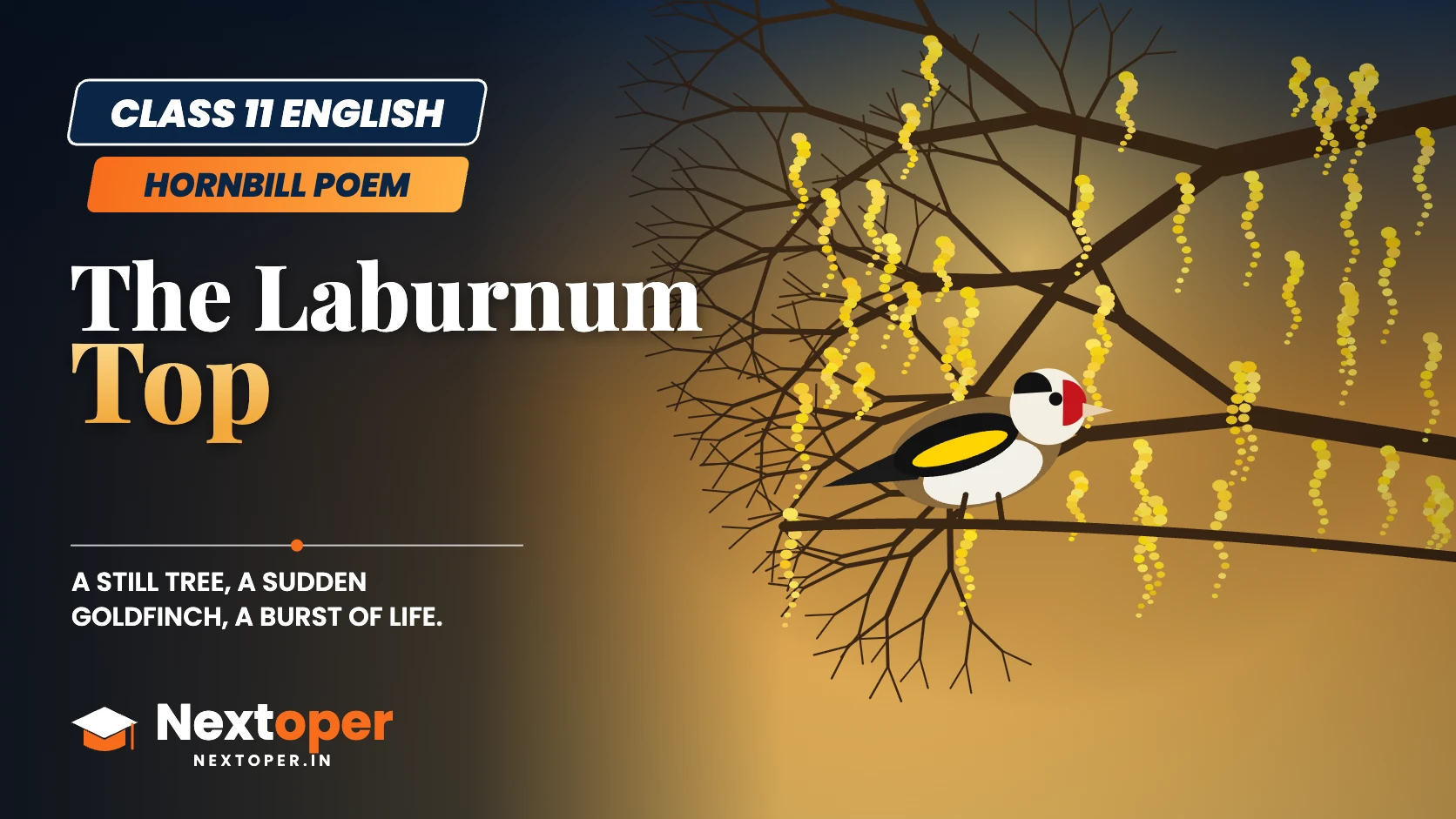
The Laburnum Top is a nature poem by Ted Hughes in Class 11 Hornbill. It describes the top of a laburnum tree on a quiet September afternoon. A goldfinch arrives to feed her young. The tree fills with sound and movement. When she flies away, it becomes empty again.
The poem captures one small moment with great detail. Use this table for quick facts.
| Fact | Detail |
|---|---|
| Book | Hornbill, NCERT Class 11 English Core |
| Place in book | Poem after Discovering Tut: the Saga Continues |
| Poet | Ted Hughes, an English poet |
| Form | One stanza in free verse |
| Season and time | A September afternoon, in yellow sunlight |
| Main subjects | A laburnum tree and a mother goldfinch with her chicks |
| Central idea | Life brings energy to stillness, then leaves it again |
You can read the poem free on the official NCERT Hornbill chapter PDF.
What happens in The Laburnum Top? (Summary)
In this Class 11 Hornbill poem, a silent tree waits in autumn sunlight. A goldfinch flies in. Her hidden chicks start chirping, and the tree shakes with life. She feeds them, pauses at a branch end, and flies off. The tree becomes silent and empty once more.
Movement 1: the silent tree
The top of the laburnum tree is silent and still. It is a September afternoon. The sunlight is yellow. A few leaves are turning yellow too. All its seeds have already fallen.
The tree seems tired and lifeless, like something at the end of a season.
Movement 2: the goldfinch arrives
Suddenly, a goldfinch lands at the end of a branch. She makes a quick, twitching chirp. Her arrival is sudden and startling.
She is smooth, alert and quick, like a lizard. She slips into the thick part of the tree, where her nest is hidden.
Movement 3: the tree comes alive
Her chicks begin to chirp and trill. Their wings tremble. The whole tree shakes with excitement.
Hughes compares the family to a machine starting up. The mother bird is the engine. She “stokes” it, filling the chicks with food, like fuel.
Movement 4: the bird leaves
She flits out to the end of a branch. Her striped face looks like a mask. She gives a soft, strange whistle. Then she flies away towards the open sky.
The laburnum settles back into emptiness. The tree is silent and still again.
Who is in The Laburnum Top?
The Laburnum Top, from Class 11 English Hornbill, has no human characters. A quiet observer, the poet, watches closely. The two main subjects are the laburnum tree and a mother goldfinch. Her chicks are heard but never seen. Each one plays a clear role in the poem’s small drama.
| Subject | What it is | Role in the poem |
|---|---|---|
| The poet | A silent observer | Watches and records every sound and movement. |
| The laburnum tree | A tree with yellow flowers, here in autumn | Silent at the start and end; alive in the middle. |
| The goldfinch | A mother songbird | Quick and alert; feeds her young; brings life. |
| The chicks | Her young, hidden in the nest | Fill the tree with chirping and trembling. |
What is the goldfinch like?
She is busy, quick and careful. She moves in sharp jerks, like a lizard. She is a devoted mother. She feeds her chicks, then leaves at once. She is the source of all the tree’s energy.
How does the tree change in The Laburnum Top?
In this Class 11 Hornbill poem, the tree goes through three states. First it is silent and still. Then the goldfinch’s arrival makes it tremble and thrill with sound. When she leaves, it subsides into emptiness. This before-during-after table answers most change questions.
| Stage | What the tree is like | Key words |
|---|---|---|
| Before the bird | Silent, still, leaves yellowing, seeds fallen | “silent, quite still” |
| During the visit | Full of chirping, trilling and trembling | “trembles and thrills” |
| After the bird leaves | Quiet and empty again | “subsides to empty” |
What are the main themes of The Laburnum Top?
The Laburnum Top, a Class 11 English Hornbill poem, has four main themes. They are the cycle of life, life bringing energy, motherhood, and close observation of nature. The tree’s stillness, burst of life, and return to silence mirror living and dying. The mother bird drives all the action.
| Theme | Where you see it |
|---|---|
| Cycle of life | Stillness, then life, then stillness again |
| Life gives energy | One small bird makes the whole tree thrill |
| Motherhood | She is the “engine” of her family; she feeds them |
| Nature observed closely | Every chirp, wing tremor and head movement is noted |
| Change of seasons | September, yellow leaves, fallen seeds |
Why is the poem called The Laburnum Top?
The action takes place at the top of the laburnum tree. The tree frames the whole poem. It is still at the start and still at the end. The title keeps our eyes on that small, changing space.
Which poetic devices are used in The Laburnum Top?
The Laburnum Top, a Class 11 English Hornbill poem, is rich in imagery and sound. Ted Hughes uses a simile, metaphors, onomatopoeia and alliteration. The bird is like a lizard. The family is a machine with an engine. Sound words like chitterings bring the scene alive. Learn these examples for device questions.
| Device | Example | Effect |
|---|---|---|
| Simile | “sleek as a lizard” | Shows her smooth, quick movement |
| Metaphor | “a machine starts up” | The chicks’ noise is like an engine starting |
| Metaphor | “engine of her family” | The mother powers her family’s life |
| Onomatopoeia | “chirrup,” “chitterings,” “trillings” | We hear the birds |
| Alliteration | “trembles and thrills” | The “t” sounds echo the shaking tree |
| Imagery | “yellow September sunlight” | Paints a quiet autumn scene |
| Contrast | Silent tree vs noisy family | Shows how life changes stillness |
What do the difficult words in The Laburnum Top mean?
Hard words in this Class 11 Hornbill poem are mostly about birds and movement. A goldfinch is a small songbird. A chirrup is a short, high chirp. Sleek means smooth and shiny. To stoke means to fill with fuel. Learning these makes the poem’s pictures clear.
| Word | Simple meaning |
|---|---|
| Laburnum | A small tree with hanging yellow flowers |
| Goldfinch | A small songbird with yellow on its wings |
| Chirrup | A short, high bird sound |
| Startlement | A sudden surprise |
| Sleek | Smooth and shiny |
| Abrupt | Sudden and quick |
| Chitterings | Quick, twittering bird sounds |
| Tremor | A small shaking movement |
| Trillings | Quick, repeated high notes |
| Stokes | Fills with fuel; here, feeds |
| Flirts out | Moves out quickly and lightly |
| Barred | Marked with stripes |
| Eerie | Strange and mysterious |
| Subsides | Settles down, becomes calm |
What are the NCERT answers for The Laburnum Top?
The NCERT exercise for this Class 11 Hornbill poem asks about the tree, the bird and images. Key questions cover the lizard simile, the engine metaphor and the bird’s mask. Below are the main questions in simple words, with our model answers. Check the exact wording in your book.
Questions are paraphrased from the NCERT exercise; check your textbook for exact wording. Answers are written by Nextoper.
Q1. What is the laburnum top like before the goldfinch arrives?
It is silent and still. It is a September afternoon in yellow sunlight. A few leaves are yellowing and all its seeds have fallen. The tree seems lifeless.
Q2. Why is the goldfinch compared to a lizard?
A lizard is sleek, alert and moves in sudden jerks. The goldfinch moves the same way. The image shows her speed and watchfulness.
Q3. What is the “machine” the poet refers to?
The machine is the goldfinch’s family of chicks. When she arrives, they begin chirping and trembling at once. It sounds like a machine starting up.
Q4. Why is the goldfinch called the “engine of her family”?
An engine gives power to a machine. The mother bird gives life and energy to her chicks. She “stokes” them with food, like fuel. Without her, the family is silent.
Q5. What does “her barred face identity mask” mean?
The goldfinch has striped markings on her face. They look like a mask. The markings identify her as a goldfinch.
Q6. What happens to the tree after the bird leaves?
The tree “subsides to empty.” It returns to its silent, still state. This shows how life comes and goes.
What MCQs come from The Laburnum Top?
Here are 10 practice MCQs on The Laburnum Top, Class 11 English Hornbill. Nextoper wrote them. Each answer has a one-line reason from the poem. They test facts, images and meaning. Cover the answers and try each question. Then check how you did.
Q1. Who wrote The Laburnum Top?
(a) Walt Whitman (b) Ted Hughes (c) Shirley Toulson (d) Markus Natten
Answer: (b) Ted Hughes.
Q2. In which month is the poem set?
(a) March (b) June (c) September (d) December
Answer: (c) A September afternoon.
Q3. What colour is the sunlight in the poem?
(a) Golden red (b) Yellow (c) White (d) Orange
Answer: (b) “Yellow September sunlight.”
Q4. Which bird visits the tree?
(a) Sparrow (b) Robin (c) Goldfinch (d) Parrot
Answer: (c) A goldfinch.
Q5. The bird is compared to a
(a) snake (b) lizard (c) cat (d) fish
Answer: (b) “Sleek as a lizard.”
Q6. The mother bird is called the ___ of her family.
(a) heart (b) engine (c) queen (d) guard
Answer: (b) Engine; she powers the family.
Q7. What has happened to the tree’s seeds?
(a) They are ripening (b) They have all fallen (c) Birds ate them (d) They are green
Answer: (b) “All its seeds fallen.”
Q8. “Chitterings” and “trillings” are examples of
(a) simile (b) onomatopoeia (c) personification (d) irony
Answer: (b) Onomatopoeia; they imitate sounds.
Q9. What does “stokes it full” mean here?
(a) Cleans the nest (b) Feeds the chicks (c) Builds a nest (d) Sings loudly
Answer: (b) She fills the chicks with food, like fuel.
Q10. At the end, the laburnum
(a) blooms again (b) falls down (c) becomes empty and still (d) fills with birds
Answer: (c) It “subsides to empty.”
What should you revise the night before the exam?
To revise this Class 11 Hornbill poem fast, learn three stages and three images. Then remember one big idea. The big idea is that life brings energy, then moves on. The tree is still, then thrilling, then still again, just like a cycle of life.
Three stages: “Still, Thrill, Still”
- Still – silent tree in September sunlight
- Thrill – goldfinch arrives; the tree trembles with life
- Still – she leaves; the tree subsides to empty
Three images: “Lizard, Machine, Mask”
- Lizard – the bird’s quick, sleek movement
- Machine / engine – the family and its power source
- Mask – the striped markings on her face
One big idea: Life arrives, energises, and leaves.
Self-check: can you answer these in one line?
| Question | Tick when you can answer |
|---|---|
| Describe the tree at the start. | [ ] |
| How does the goldfinch arrive? | [ ] |
| Why the lizard comparison? | [ ] |
| What is the “machine”? | [ ] |
| Who is the “engine”? | [ ] |
| What is her “identity mask”? | [ ] |
| How does the poem end? | [ ] |
What practice questions can you try on The Laburnum Top?
These are Nextoper practice questions on The Laburnum Top, Class 11 English Hornbill. They are not previous-year board questions. They follow the usual short-answer, long-answer and extract formats. Write full answers first. Then compare them with the summary, stages and devices on this page.
Short answer (about 40-50 words)
- How does the poet show the season in the opening lines?
- What sounds does the poet use to bring the tree alive?
- Why does the goldfinch leave so quickly?
- How is the ending similar to the beginning?
- What does the poem suggest about motherhood?
Long answer (about 120-150 words)
- The Laburnum Top is a poem of contrasts. Discuss.
- How does Ted Hughes use images of machines in a nature poem?
- Describe a moment in nature you watched closely, in the poem’s style.
Extract-based practice
Read: “It is the engine of her family.”
- Who is “her” in this line?
- Why is she called an engine?
- Name the device used.
What mistakes do students make in The Laburnum Top?
Students often lose marks on The Laburnum Top, Class 11 English Hornbill, through small slips. Common errors include setting it in spring and calling the bird a male. Another is thinking the tree is in full bloom. Check each fact below against the NCERT text before you write your answer.
| Common mistake | What the poem says |
|---|---|
| “The poem is set in spring” | It is a September afternoon. |
| “The tree is in full bloom” | Leaves are yellowing; all its seeds have fallen. |
| “The bird is male” | The goldfinch is “her,” a mother bird. |
| “The tree is the engine” | The mother bird is the engine of her family. |
| “The bird is compared to a snake” | She is “sleek as a lizard.” |
| “The chicks fly away with her” | Only she launches away; the tree goes quiet. |
| Saying Walt Whitman wrote it | Ted Hughes wrote it. |
What is the short answer on The Laburnum Top?
Short answer
The Laburnum Top is a Ted Hughes nature poem in Class 11 Hornbill. A laburnum tree stands silent on a September afternoon. A mother goldfinch flies in to feed her chicks. The tree trembles with their chirping. She is the engine of her family. When she leaves, the tree becomes empty again.
What do students ask about The Laburnum Top?
Students most often ask who wrote The Laburnum Top and what it means. They also ask why the bird is like a lizard and an engine. One more common question is about the poem’s theme. Short, exam-ready answers to all five follow below, each based on the poem.
Who wrote The Laburnum Top?
Ted Hughes wrote The Laburnum Top. It is the second poem in Hornbill, the NCERT Class 11 English textbook.
What is The Laburnum Top about?
A goldfinch visits a silent laburnum tree to feed her chicks. The tree fills with life. When she leaves, it falls silent again.
Why is the goldfinch compared to a lizard?
Like a lizard, she is sleek, alert and moves in sudden jerks. The image shows her quick, careful movement.
Why is the bird called an engine?
She powers her family, the “machine.” She feeds her chicks like fuel. Her arrival starts the noise; her exit stops it.
What is the theme of The Laburnum Top?
The theme is the cycle of life. Life brings energy to stillness, then leaves. It also celebrates a mother’s care and close attention to nature.
Found a mistake? Report an error and we will fix it.
What is the key takeaway from The Laburnum Top?
This Class 11 Hornbill poem shows how one small life can change a scene. A quiet tree becomes a buzzing home, then goes quiet again. The poem trains you to notice tiny details in nature. It also reminds you that energy and life always come and go.
Revise “Still, Thrill, Still” and “Lizard, Machine, Mask.” Then you can answer almost any question on it.
Next poem: Hornbill stays with nature, but now nature speaks. Read The Voice of the Rain notes next.
Related notes
Read these notes next to keep your Class 11 English Hornbill revision in book order. The hub page lists every chapter and poem in one place.
About the author and reviewer
How we prepared this: These notes are based on NCERT Hornbill (2026-27 reprint). We wrote every explanation in our own words and updated the page on 2 November 2026.