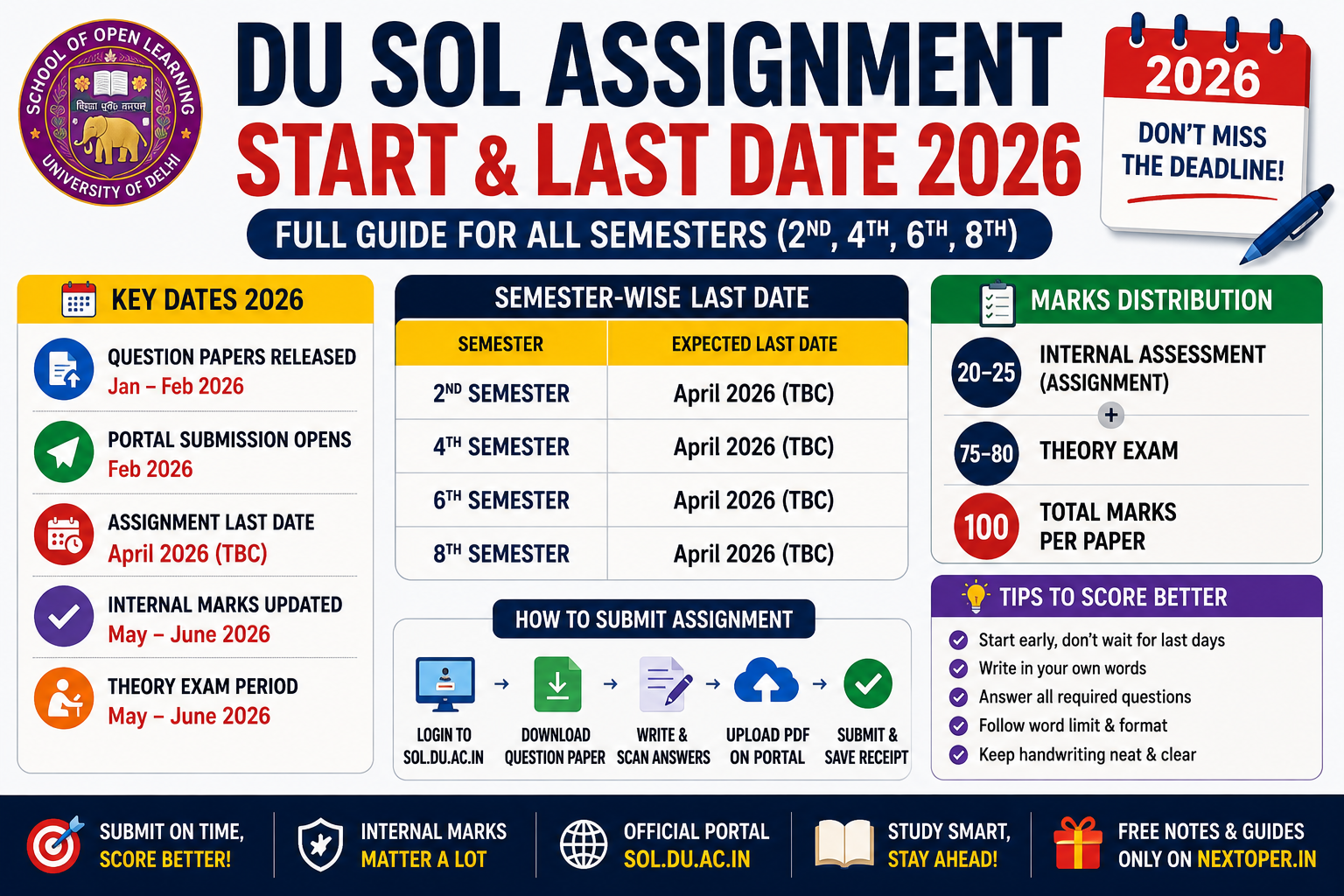
DU SOL Assignment Start & Last Date 2026 — Full Guide
| Field | Detail |
|---|---|
| Applies To | DU SOL Students — All Semesters (2nd, 4th, 6th, 8th) |
| Subject / Topic | DU SOL Assignment Submission 2026 |
| Board / University | University of Delhi — School of Open Learning (SOL) |
| Key Concepts | Start Date, Last Date, Portal Submission, Marks Distribution |
| Official Source | sol.du.ac.in |
| Helpful For | Assignment submission, internal marks, exam eligibility |
The DU SOL assignment start date and last date for 2026 are the two most searched pieces of information by lakhs of SOL students every semester — and missing either one can seriously affect your internal marks and exam eligibility.
If you just got your admit card reminder or heard classmates talking about assignment deadlines, that mix of panic and confusion is completely understandable. SOL’s official communication doesn’t always reach students clearly, and third-party sites often give outdated or vague dates. You deserve one clean, honest breakdown.
DU SOL assignments work as your internal assessment, carrying 20–25 marks depending on your programme. Whether you’re in the 2nd, 4th, 6th, or 8th semester of BA/BCom/BA(Prog), there’s a specific window to submit — and a hard last date after which the portal typically closes. This guide walks through every date, every step, portal login, marking scheme, scoring tips, and what to do if you’re running late. If you’re a Delhi student juggling work, family, and studies through distance education, this is exactly where you need to be.
What’s in This Guide?
- What Is DU SOL and How Does Its Assignment System Work?
- Why Is DU SOL Assignment Important? The Marks Reality No One Tells You
- DU SOL Assignment Submission 2026 — Key Dates at a Glance
- DU SOL Assignment Last Date 2026 — Semester-Wise Deadline Table
- Where and How to Submit DU SOL Assignment — Portal Login & Steps
- DU SOL Assignment Format and Writing Guidelines
- DU SOL Internal Assessment 2026 — Marking Scheme Explained
- What Happens If You Miss the DU SOL Assignment Last Date?
- DU SOL Internal Assessment Result and Marks Update — What to Expect
- Tips to Score Better in Your DU SOL Assignment
- Common Mistakes to Avoid in DU SOL Assignment
- DU SOL Assignment FAQ — Questions Students Actually Ask
- 6 Things to Do Right Now — A Practical Checklist
- Explore More on Nextoper — Related Guides
- Official Resources That Will Help You
What Is DU SOL and How Does Its Assignment System Work?
DU SOL — the School of Open Learning under the University of Delhi — is one of the largest distance education institutions in India. It offers undergraduate programmes in BA, BCom, and BA (Honours) to students who cannot attend regular college due to work, location, financial constraints, or other personal reasons. Lakhs of students across Delhi, UP, Haryana, Bihar, and beyond are enrolled under SOL at any given time.
Unlike regular DU colleges where attendance and internal marks come from classroom participation, DU SOL uses a structured assignment system to generate your internal assessment score. There are no surprise class tests. There is no attendance sheet. The assignment you submit through the portal is the single mechanism by which SOL evaluates your preparation beyond the final exam.
How the SOL Assignment System Is Structured
Each semester, SOL releases assignment question papers for every subject. These papers contain a set of questions — usually 5 to 8 per subject — out of which you are required to answer a specified number. You write your answers, scan them, and upload the file to the official portal at sol.du.ac.in within the announced submission window.
A student from Meerut who commutes to Delhi for work once described the SOL assignment system as “the one time in the year when the university actually looks at your thinking, not just your exam score.” That’s accurate — evaluators aren’t skimming for memorized lines. They’re checking whether you understood the concept and expressed it in your own words. Understanding this system is step one. The second step is knowing your dates — because the window closes whether you’re ready or not.
Why Is DU SOL Assignment Important? The Marks Reality No One Tells You
Many students treat the DU SOL assignment as optional paperwork. It is not. Your assignment marks directly form part of your final result for every paper in your semester. Skipping or missing this submission doesn’t just mean losing a few marks — it can mean losing up to 25 marks per subject, which pulls your division from First to Second or pushes you from a pass to a fail in aggregate scoring.
The Numbers That Matter
| Component | Marks |
|---|---|
| Internal Assessment (Assignment) | 20–25 marks |
| Theory Examination | 75–80 marks |
| Total Per Paper | 100 marks |
For a student appearing in 5 papers in a semester, internal assessment represents up to 125 marks in total. That is not a rounding error — it’s a quarter of your semester scorecard. Students who score 60 in theory but have 20 internal marks comfortably reach 80 per paper. Students who score 65 in theory with zero internal marks land at 65 — a gap that determines whether you’re in first division or not.
Beyond marks, the assignment also builds your subject understanding before the theory exam. Writing out answers for the question paper acts as a dry run for exam preparation. Students who submit thoughtful assignments consistently report feeling better prepared for the main exam. The benefit is double — marks now, clarity later.
DU SOL Assignment Submission 2026 — Key Dates at a Glance
The DU SOL assignment submission 2026 follows a semester-wise schedule. The academic year 2025–26 covers even semester exams (2nd, 4th, 6th, 8th) in the first half of 2026. The table below covers the even semester cycle that most currently enrolled students are preparing for.
| Event | Expected Date (Even Semester) |
|---|---|
| Assignment Question Papers Released | January–February 2026 |
| Portal Submission Window Opens | February 2026 |
| DU SOL Assignment Last Date | April 2026 (TBC — confirm on sol.du.ac.in) |
| Grace Period (If Offered) | 5–10 days post last date (not guaranteed every year) |
| Internal Marks Updated in Dashboard | May–June 2026 |
| Theory Examination Period | May–June 2026 |
TBC = To Be Confirmed. SOL releases exact dates via notice on sol.du.ac.in. The dates above follow the pattern of the 2023–25 sessions. Always verify the current year’s dates before planning your submission.
Mark these in your phone calendar right now — not just the last date, but the portal opening date too. Students who know when the window opens, submit early, avoid technical rush-hour errors, and sleep better in April.
DU SOL Assignment Last Date 2026 — Semester-Wise Deadline Table
The DU SOL assignment last date is the single most important date in your semester calendar. Once this date passes, the online portal typically locks submissions, and offline or email alternatives are rarely accepted without documented special circumstances.
Expected Last Dates — Even Semester 2026
| Semester | Programme | Expected Last Date | Consequence of Missing |
|---|---|---|---|
| 2nd Semester | BA / BCom / BA(Prog) | April 2026 (TBC) | Internal marks = 0 for that semester |
| 4th Semester | BA / BCom / BA(Prog) | April 2026 (TBC) | Affects division and CGPA |
| 6th Semester | BA / BCom / BA(Prog) | April 2026 (TBC) | Critical — final year risk |
| 8th Semester | BA Honours | April 2026 (TBC) | Highest risk — no standard recovery |
SOL sometimes provides a grace period of 5–10 days after the announced last date due to portal traffic or student requests. This is not guaranteed every year and should never be your plan. A student from Laxmi Nagar submitted during the grace window in 2025, only to find the portal had crashed from overload during her session. Her submission didn’t register, and she had to write to the SOL office and wait weeks for resolution. Submit early — every day before the last date is a safer day.
Where and How to Submit DU SOL Assignment — Portal Login & Steps
The only authorised place to submit your DU SOL assignment is the official portal at sol.du.ac.in. No third-party website, coaching centre platform, or email address is an official submission channel. Anyone claiming otherwise is misinformed or misleading you.
DU SOL Assignment Login Portal — How to Access
- Open your browser and go directly to sol.du.ac.in
- Click “Student Login” or “Assignment Submission” in the homepage menu
- Enter your enrollment number and registered password
- If you’ve forgotten your password, use “Forgot Password” — reset via your registered mobile number or email
- After login, navigate to “Assignment” in your student dashboard
Step-by-Step Submission Process
- Select your programme and current semester — choose carefully; a wrong selection submits to an incorrect module with no easy undo
- Download the assignment question paper for each subject — read all instructions before writing a word
- Write your answers following the format guidelines (see next section)
- Scan your assignment into a clear PDF — one file per subject, pages in order
- Upload each subject’s file to the corresponding paper slot on the portal
- Preview the uploaded file before clicking submit — verify it’s the correct file and all pages are legible
- Click Submit and immediately download or screenshot the confirmation — this acknowledgement is your only proof
Use Wi-Fi rather than mobile data for uploading PDF files. If the portal shows a timeout error mid-upload, log back in and check your dashboard — the file may have saved as a draft. If not, re-upload and verify before closing your browser.
DU SOL Assignment Format and Writing Guidelines
Most guides online tell you when to submit — very few explain how your assignment should look. Evaluators follow a format checklist, and getting it wrong costs marks even when your answers are correct.
Handwritten vs. Typed
DU SOL accepts both handwritten and typed assignments. For most humanities and commerce subjects — BA History, BA Political Science, BCom, BA Economics — handwritten is strongly preferred by evaluators. Typed assignments may be acceptable for certain elective papers. The specific instruction will be mentioned on your assignment question paper.
Assignment Format: Quick Reference Table
| Requirement | Specification |
|---|---|
| Paper size | A4, white, single-sided |
| Writing instrument | Blue or black ink — clear, legible |
| Cover page | Mandatory — name, enrollment number, course, semester, subject |
| Word count | 300–500 words per long answer; 100–150 per short answer (confirm in question paper) |
| Language | Match your declared medium — Hindi or English |
| File format for upload | PDF preferred; JPEG accepted if PDF not possible |
| File size | Under 10 MB per subject (compress at ilovepdf.com if needed) |
| Scan quality | Clear, well-lit, pages flat — no shadows, no cut-off edges |
A student from Patparganj submitted without a cover page in 2024 and received zero marks for that paper. The evaluator couldn’t verify her identity against the submission. All correct answers, zero marks — because of one missing page. Write your cover page first, every time.
What Good Answers Look Like
Write in your own words. DU SOL evaluators review hundreds of assignments per subject. Copied text from guides is immediately recognisable and consistently scores lower. A 350-word answer that explains a concept clearly in student language will outscore 600 copied words. Your goal is demonstrated understanding, not volume.
DU SOL Internal Assessment 2026 — Marking Scheme Explained
Understanding how your DU SOL internal assessment marks are calculated helps you write smarter answers and set realistic score targets before you sit down to write.
Marks Distribution by Programme
| Programme | Internal Assessment Marks | Theory Marks | Total Per Paper |
|---|---|---|---|
| BA Programme | 20 marks | 80 marks | 100 |
| BCom | 20 marks | 80 marks | 100 |
| BA Honours | 25 marks | 75 marks | 100 |
What Evaluators Actually Check
Evaluators assigned by DU SOL score each answer on four key parameters:
- Relevance — Did you answer what was actually asked, or did you write around it?
- Depth — Did you explain the concept with examples, not just define it?
- Clarity — Is the handwriting legible and the argument easy to follow?
- Completeness — Did you attempt the required number of questions with adequate length?
There is no negative marking in internal assessment. Attempting all required questions — even partially — is always better than leaving any blank. A partial answer earns partial marks. A blank earns zero, every time.
What Happens If You Miss the DU SOL Assignment Last Date? [GAP FILL]
This is the question every student searches in a panic — and almost no guide answers it with honesty. Here is the full picture.
Immediate Consequences of Missing the Deadline
- Your internal assessment marks for all papers that semester are recorded as zero
- You are generally still permitted to appear in the theory examination — SOL does not usually bar exam entry solely for missing assignments
- Your final result carries zero internal marks, reducing your total per paper by 20–25 marks
- This can push you from a pass to a fail in aggregate, or from first division to second division
Is There Any Way to Recover?
In documented exceptional cases — medical emergencies, hospitalisation, or verifiable portal failures — students have written to the SOL Controller of Examinations and received consideration on a case-by-case basis. This is not a policy. There is no standard process.
If you need to attempt this route:
- Write a formal application to the Controller of Examinations, SOL, University of Delhi
- Attach supporting documents — hospital records, doctor’s certificate, or portal error screenshots with timestamps
- Submit in person or by registered post to the SOL office, North Campus
This process takes weeks and has no guaranteed outcome. The only reliable strategy is to submit before the official last date.
DU SOL Internal Assessment Result and Marks Update — What to Expect
After submitting your assignment, there is a waiting period before your marks appear on your dashboard. Many students refresh their portal daily after submission — but the timeline doesn’t work that way.
Expected Marks Update Timeline
| Stage | Expected Timing |
|---|---|
| Portal submission window closes | April 2026 |
| Evaluator review and marking period | April – May 2026 |
| Marks uploaded to student dashboard | May – June 2026 |
| Combined result (internal + theory) declared | After theory exam results |
Your internal assessment marks appear under the “Result” or “Marks” section of your student dashboard at sol.du.ac.in. Log in from May 2026 to check whether your submission has been processed and marked.
If your marks show as zero despite having submitted, first confirm your acknowledgement receipt shows the submission was registered. If you have proof of submission but marks still show zero, write to the SOL examination department with your enrollment number, subject name, and the confirmation screenshot. This occasionally happens due to portal syncing delays and is typically resolved within a few weeks.
Tips to Score Better in Your DU SOL Assignment
Submitting on time earns you the marks. Submitting well earns you good marks. These tips come from patterns that consistently produce higher internal assessment scores across SOL subjects.
Start Writing the Week the Portal Opens
Download your question papers as soon as the portal activates and attempt all answers within the first week. You’ll have time to review, improve, and rewrite — rather than rushing through the night before the last date.
Answer Every Required Question — Even Partially
Never leave a question blank because you’re unsure. Write whatever you understand about the topic. Partial credit is real, and a partially answered question will always score more than an empty page.
Use Real Indian Examples in Your Answers
If a BCom question asks about “methods of business finance,” a student who references Indian examples — like MSME loans, mudra yojana, or equity markets — scores noticeably higher than one who gives a generic definition. Evaluators look for applied understanding tied to real contexts they recognise.
Verify Word Counts Before Finalising
Most assignment question papers specify expected word counts per question. Students who write 150 words for a question expecting 400 leave marks on the table. Read the question paper instructions carefully before you begin each answer.
Keep Handwriting Legible Even When Tired
Rushed, cramped handwriting — especially at the end of long answer sessions — is harder to read and less favourably evaluated. Write at a steady pace. Leave space between answers. Use margins. Presentation isn’t graded separately, but it shapes how your content is received.
Common Mistakes to Avoid in DU SOL Assignment
These mistakes cost SOL students marks every single year — and none of them are knowledge gaps. They’re entirely avoidable with a few minutes of attention.
Mistake 1: Submitting the Wrong Subject File
Always preview your uploaded PDF before clicking submit. Students who scan multiple subjects and mix up files end up submitting Economics answers under History. The portal cannot detect this — only your preview step can catch it.
Mistake 2: Missing the Cover Page
The most common reason for zero marks that had nothing to do with answer quality. Write your cover page first — name, enrollment number, course, semester, subject — before you begin answering anything.
Mistake 3: Waiting Until the Final 48 Hours
Portal traffic peaks in the last two days before the last date. Slow uploads, session timeouts, and server crashes are all more common in this window. Submitting a week early eliminates this entirely.
Mistake 4: Using Third-Party Submission Services
Multiple websites charge fees to submit DU SOL assignments on your behalf. These are not authorised. Your submission must come directly from your own login at sol.du.ac.in. Anything else will not be counted by evaluators.
Mistake 5: Copying Answers from Study Material
Evaluators see the same copied lines hundreds of times per subject. Paraphrase, use examples, and write in your natural language. Original expression at moderate length consistently scores higher than copied text at full length.
Mistake 6: Not Saving the Submission Confirmation
Screenshot or download the acknowledgement page immediately after submitting. This is your only proof if any dispute arises about whether your submission was received. SOL records are the authority, but your receipt protects you if there’s a mismatch.
DU SOL Assignment FAQ — Questions Students Actually Ask
Q: When will the DU SOL assignment portal open for even semester 2026? A: Based on past sessions, the DU SOL assignment portal opens in February 2026 for even semester students. Check sol.du.ac.in daily from February 1 — the portal goes live without a major announcement, so you need to watch for it yourself rather than waiting for a notification.
Q: Can I submit my DU SOL assignment after the last date? A: Normally the portal closes on the last date and late online submissions aren’t accepted. In rare cases involving medical emergencies or documented portal errors, students can write to the SOL Controller of Examinations. There’s no guarantee this will be accepted, so always treat the official last date as your final deadline.
Q: What happens to my internal marks if I miss the DU SOL assignment submission? A: Your internal assessment marks for that semester are recorded as zero. You can still appear in the theory exam, but your total per paper drops by 20–25 marks. For students chasing first division or specific percentage cutoffs, this is a result-defining loss that’s very hard to recover from.
Q: How many questions do I need to attempt in the DU SOL assignment? A: The question paper tells you — typically 3 to 5 questions out of 5 to 8 listed. Download your subject’s question paper first and read the instruction line at the top before you begin writing. Never start without reading the full instruction.
Q: Will my DU SOL assignment marks show up before or after the theory exam? A: Internal assessment marks are typically updated in your student dashboard between May and June 2026, after the submission portal closes and evaluators complete their review. Your combined result — internal plus theory — is declared after the theory exam results are published.
6 Things to Do Right Now — A Practical Checklist
- Log in to sol.du.ac.in today and verify your enrollment number and password work — discover login problems now, not when you’re trying to submit.
- Set a February 2026 calendar reminder to check sol.du.ac.in daily from February 1 for when the assignment portal goes live.
- Download your subject question papers the day the portal opens — read all instructions before picking up a pen or opening a document.
- Prepare your cover page template right now — write out your name, enrollment number, course, semester, and subject so it’s ready to attach to every subject’s assignment.
- Test a PDF compression and upload using ilovepdf.com and your scanning app, so you’re not troubleshooting file sizes on the submission day.
- Set a personal submission deadline 7 days before the official DU SOL assignment last date — if the portal shows April 30, your personal cut-off is April 23.
Explore More on Nextoper — Related Guides
SOL’s academic system has many connected parts. These are the guides most useful to read alongside this one:
- PCB vs PCM Stream: Easy Steps to Choose the Right One
- Class 11 Subject Combination: Free Complete Guide for Students
- Best Courses After 12th: Complete Stream-Wise Guide for 2026
- Career Options After 12th Arts
Official Resources That Will Help You
1. sol.du.ac.in — DU School of Open Learning Official Portal This is the only authorised website for submitting your DU SOL assignment, downloading question papers, and reading official date notices. Bookmark it and return every week during the assignment season. Every other website is a secondary source.
2. du.ac.in — University of Delhi Main Website The University of Delhi’s official site publishes academic calendars, exam schedules, and policy circulars that affect all affiliated units including SOL. Use this to cross-reference any date or eligibility rule you’re uncertain about.
3. ncert.nic.in — NCERT Official Resource Portal For SOL students whose assignment questions draw on foundational concepts in social sciences, commerce, or humanities, NCERT’s freely available textbooks provide accurate, citable reference material that evaluators recognise and respond well to.
Missing an assignment deadline in distance education feels different from missing one in a regular college — there’s no teacher chasing you, no classmate reminding you, and no notice pinned to a physical board. That silence is real, and it trips up thousands of SOL students every year.
Think of a student like Deepak from Faridabad — working part-time, managing household responsibilities, studying for exams late at night — who submitted his DU SOL assignment on the announced last day at 11 PM and earned his full internal marks despite everything working against him. The difference between him and those who missed wasn’t ability or free time — it was knowing the exact date and having a plan made two weeks earlier. Your next step is simple: open sol.du.ac.in right now, confirm your login works, and set that February calendar reminder. Everything else on nextoper.in is here to back you up when you need it.