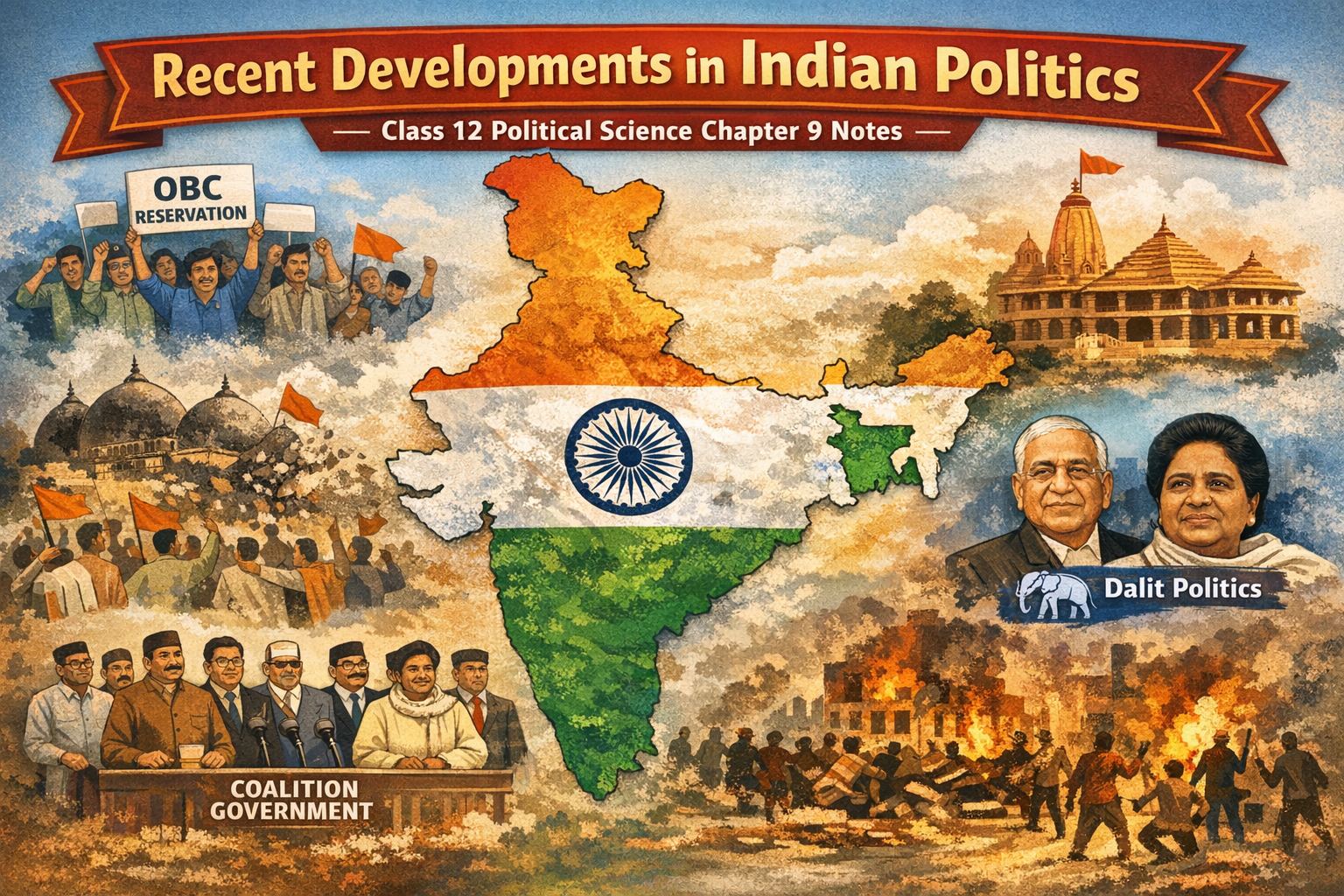
Class 12 Political Science Chapter 5 Notes | Challenges to and Restoration of Congress System
Meta Title: Class 12 Pol Science Ch 5 Notes – Congress System
Meta Description: Read clear and exam-ready Class 12 Political Science Chapter 5 notes on Challenges to and Restoration of Congress System. Covers key concepts, important points, and questions.
Introduction
Chapter 5 of Class 12 Political Science (CBSE) takes students through one of the most significant phases in Indian democratic history. It explains how the Indian National Congress dominated politics after independence, the internal and external challenges it faced, and how it eventually restored its position under Indira Gandhi. Understanding this chapter is essential for building a strong foundation in Indian political history.
What Is the Congress System?
After India gained independence, it officially adopted a multi-party democratic system. However, in practice, politics between 1952 and 1964 was largely shaped by a single party — the Indian National Congress.
Indian political scholar Rajni Kothari described this phase as the “Congress system,” while Morris Jones called it “one-party dominance.” What made India’s case unique was that this dominance was not forced or authoritarian. It was earned through free and fair elections and public trust built during the freedom struggle.
During this period, Congress played a dual role — it was both the ruling party and the de facto opposition, maintaining a democratic balance within the system.
India’s First General Election (1951–1952)
Once the Constitution came into force in January 1950, India prepared for its first-ever general election. The Election Commission of India, led by Chief Election Commissioner Sukumar Sen, conducted the elections between October 1951 and February 1952.
The Congress Party won a decisive majority, which formally established one-party dominance in independent India.
Challenges Faced by the Election Commission
Organising elections in a newly independent, largely illiterate country was no small task. The Election Commission had to deal with:
- Conducting free and fair elections across a vast territory
- Demarcating hundreds of parliamentary and state constituencies
- Preparing accurate voter lists for millions of citizens
- Training election officials and polling staff at scale
Despite these challenges, the election was successfully conducted and is considered a landmark moment in India’s democratic history.
Why Did Congress Dominate Indian Politics?
Congress did not dominate simply because it was organised well. Several deeper reasons explain its long-standing popularity:
- It led India’s independence movement, giving it unmatched national credibility
- It had a strong grassroots presence across states and rural areas
- Leaders like Jawaharlal Nehru commanded enormous public respect
- The party followed an inclusive approach, appealing to people across regions, castes, and religions
- It projected a vision of secular, democratic, and socialist India
Related CBSE Notes
If you are studying India’s Foreign Relations Notes, you should also check:
- Class 12 Political Science Chapter 6 – International Organisations Notes
- Class 12 Political Science Chapter 7 – Security in the Contemporary World
- Class 12 Political Science Chapter 8 – Regional Aspirations Notes
These CBSE notes will help you build a strong understanding of Political Science concepts.
Leadership Transitions After Nehru
Lal Bahadur Shastri (1964–1966)
After Nehru’s death in May 1964, Lal Bahadur Shastri was elected as Prime Minister. Despite being a soft-spoken leader, he handled two major crises during his brief tenure:
- The Indo-Pak War of 1965, where India held its ground
- A severe food shortage crisis, which challenged national stability
Shastri’s sudden death in Tashkent in January 1966 led to yet another leadership transition within Congress.
Indira Gandhi Comes to Power
After Shastri’s death, Indira Gandhi was chosen as Prime Minister — a decision largely influenced by the Congress Syndicate, which believed she would be easy to control. That calculation turned out to be wrong.
Indira Gandhi proved to be an assertive and politically shrewd leader who would reshape Indian politics.
The Fourth General Election (1967): A Major Turning Point
The 1967 general elections were a wake-up call for the Congress Party. For the first time, the opposition made significant gains at both the national and state levels.
Key outcomes of the 1967 elections:
- Congress’s vote share dropped considerably
- Non-Congress governments came to power in several states
- Regional parties and left-wing groups gained greater influence
- The era of unchallenged Congress dominance began to crack
This election marked the beginning of competitive multi-party politics in India.
The Congress Split (1969) and Indira Gandhi’s Revival
Conflict with the Syndicate
The Congress Syndicate — a group of powerful senior party leaders — tried to limit Indira Gandhi’s authority. In response, she began pursuing an independent political agenda, which eventually led to an open conflict within the party.
In 1969, Congress formally split into two factions:
- Congress (R) — led by Indira Gandhi (the “R” stood for Requisitionists)
- Congress (O) — led by the old Syndicate leaders (the “O” stood for Organisation)
Indira’s Socialist Push
To build public support, Indira Gandhi adopted a strongly socialist platform. Key moves included:
- Nationalisation of 14 major banks (1969) — to reduce inequality and expand credit access
- The powerful slogan “Garibi Hatao” (Remove Poverty), which directly appealed to India’s poor
- Abolition of privy purses of former kings and princes
These decisions were bold, popular, and politically effective.
The 1971 Election Victory
Indira Gandhi called for early elections in 1971 and won a massive landslide victory. Congress returned to power with a stronger mandate than before, and she emerged as one of India’s most powerful Prime Ministers. This is often described as the restoration of the Congress system.
Rise of Coalition Politics (Post-1977)
The political landscape shifted significantly after the Emergency period (1975–1977). In the 1977 general elections:
- The opposition united to form the Janata Party, defeating Congress for the first time at the Centre
- This was a historic moment — India had its first non-Congress government at the national level
However, the Janata government faced internal divisions and collapsed within two years. Congress returned to power in 1980, again under Indira Gandhi.
This period marked India’s gradual transition from one-party dominance to a system of coalition politics, where alliances like the NDA and UPA became the standard model of governance.
Important Points to Remember
- The term “Congress system” was coined by Rajni Kothari to describe Congress’s dominance between 1952 and 1964
- India’s first general election was held from October 1951 to February 1952, overseen by Sukumar Sen
- Unlike one-party systems in China or Mexico, India’s Congress dominance was democratic and election-based
- The 1967 elections ended Congress’s unquestioned hold over Indian politics
- The 1969 Congress split was caused by Indira Gandhi’s conflict with the Syndicate
- Bank nationalisation and “Garibi Hatao” were key policies that helped Indira win the 1971 elections
- The 1977 elections brought the Janata Party to power — India’s first non-Congress central government
- Coalition politics became the norm in Indian politics from the late 1970s onward
Important Questions for CBSE Exams
- What is meant by the “Congress system”? Who coined this term and why?
- What were the main challenges faced by the Election Commission during India’s first general election?
- How did the 1967 elections mark a turning point in Indian political history?
- What led to the split of the Congress Party in 1969? Name the two factions that emerged.
- Explain the significance of Indira Gandhi’s “Garibi Hatao” slogan in the context of the 1971 elections.
- Why did the Janata Party come to power in 1977, and why did it fail to complete its term?
- How did India’s political system shift from one-party dominance to coalition politics?
- Compare India’s one-party dominance with that seen in countries like China or Mexico.
Conclusion
Chapter 5 of Class 12 Political Science traces a critical arc in India’s democratic journey — from the overwhelming dominance of the Congress Party in the 1950s to the emergence of a genuinely competitive multi-party system by the late 1970s. The 1967 elections, the 1969 Congress split, Indira Gandhi’s 1971 victory, and the rise of coalition politics are the central events students must understand and connect. Studying this chapter helps make sense of not just India’s past, but the political structure that governs the country today.
Stay Updated with CBSE Notes
For more useful study material, notes, and updates, follow us on Instagram and stay connected.



Pingback: The Crisis of Democratic Order Class 12 CBSE – Complete Notes with 10 Must-Know Concepts
Pingback: CBSE Class 12 Rise of Popular Movements – Complete Notes | Nextoper - Nextoper