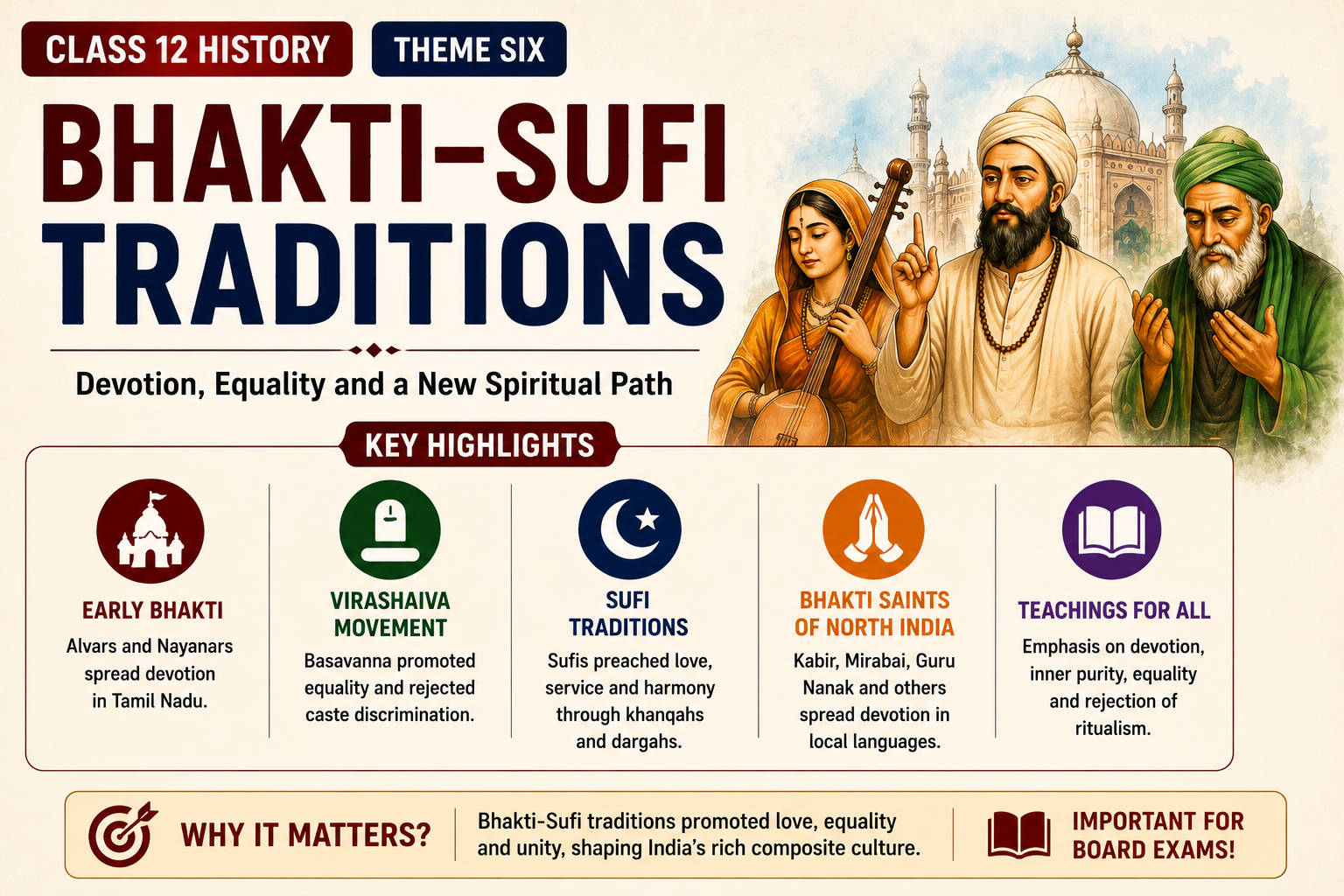
Bhakti Sufi Traditions Class 12 CBSE – Complete Free Notes
| Field | Detail |
|---|---|
| Chapter | Theme Six – Bhakti-Sufi Traditions |
| Subject | History |
| Class | 12 |
| Board | CBSE |
| Difficulty | Important |
Bhakti Sufi Traditions Class 12 CBSE covers one of the most dynamic periods of Indian religious history — from the eighth to the eighteenth century — when devotional movements reshaped how ordinary people related to God, cutting across barriers of caste, gender, and language. The chapter traces the rise of poet-saints like the Alvars and Nayanars in Tamil Nadu, the Virashaiva movement in Karnataka, the Sufi orders in the Deccan and Delhi, and towering figures like Kabir, Baba Guru Nanak, and Mirabai in north India.
For board exams, this chapter carries heavy weight. Expect source-based questions from the primary texts included in the NCERT — Kabir’s dohas, Basavanna’s vachanas, Jahanara’s pilgrimage account — along with 5-mark essay questions on Sufism, bhakti saints, and the relationship between religious movements and the state. The chapter also regularly appears in map-based questions asking you to locate dargahs and temple sites.
Even today, millions of Indians visit the dargah of Khwaja Muinuddin Chishti in Ajmer or sing Mirabai’s bhajans at home — these traditions are not just history, they are living practice. Understanding nirguna and saguna bhakti helps you see why devotional music, from qawwali to kirtana, continues to draw such enormous crowds across the country.
What’s in These Notes?
- Core Bullet Notes — Section-wise NCERT Coverage
- Important Terms / Glossary
- Timeline of Major Religious Teachers
- Key Personalities
- Saguna vs Nirguna Bhakti — Comparison Table
- Important Questions — Bhakti Sufi Traditions Class 12 CBSE
- FAQ — Bhakti Sufi Traditions Class 12 CBSE
- Quick Revision — Key Points to Remember
- Explore More CBSE Notes on Nextoper
- Trusted Resources for Deeper Study
Core Bullet Notes — Bhakti Sufi Traditions
A. Mosaic of Religious Beliefs and Practices
- By the mid-first millennium CE, the subcontinent had stupas, monasteries, and temples reflecting a wide range of religious beliefs.
- Two major processes shaped this mosaic: (1) dissemination of Brahmanical ideas through Puranic texts written in simple Sanskrit for women and Shudras, and (2) Brahmanas accepting and reworking local beliefs and practices.
- The deity Jagannatha at Puri, Orissa, is a prime example — a local tribal deity incorporated as a form of Vishnu by the twelfth century, yet represented very differently from other Vishnu images.
- Local goddesses were brought into the Puranic framework by identifying them as wives of Vishnu (Lakshmi) or Shiva (Parvati).
- Tantric practices were widespread and open to both women and men; practitioners often ignored caste differences in ritual contexts. They influenced Shaivism and Buddhism particularly in eastern, northern, and southern India.
- Conflicts existed between Vedic orthodoxy and Tantric practitioners. Followers of Vishnu or Shiva often claimed their deity was supreme. Buddhism and Jainism were also in tension with emerging bhakti traditions.
- Devotional worship had existed for about a thousand years before the eighth century, ranging from temple rituals to ecstatic states where devotees sang and chanted compositions.
B. Early Bhakti Traditions — Alvars and Nayanars
- Bhakti traditions are classified into two types: saguna (worship of God with attributes — Vishnu, Shiva, Devi in human-like forms) and nirguna (worship of an abstract, formless God).
- The Alvars (literally “immersed in devotion to Vishnu”) and Nayanars (leaders devoted to Shiva) led the earliest bhakti movements, beginning around the sixth century CE in Tamil Nadu.
- They travelled from place to place, singing hymns in Tamil. Shrines they identified became pilgrimage centres where large temples were later constructed.
- Devotees came from all social backgrounds — Brahmanas, artisans, cultivators, and even those considered “untouchable.” This challenged dominant caste hierarchies.
- The Nalayira Divyaprabandham, an anthology of compositions by the twelve Alvars, was described as the “Tamil Veda” — claiming equal authority to Sanskrit sacred texts.
- Andal, a woman Alvar, expressed her devotion to Vishnu through love poetry; her compositions are sung to this day. Karaikkal Ammaiyar, a Nayanar devotee of Shiva, chose extreme asceticism, deliberately rejecting conventional feminine beauty — her self-description as a demoness was a challenge to patriarchal norms.
- The Chola rulers (ninth to thirteenth centuries) built magnificent Shiva temples at Chidambaram, Thanjavur, and Gangaikondacholapuram. King Parantaka I consecrated metal images of the Nayanar saints Appar, Sambandar, and Sundarar in a Shiva temple around 945 CE. Think of it as ancient state PR — kings built temples to show divine backing.
- The compositions of Appar, Sambandar, and Sundarar were compiled into the Tevaram in the tenth century.
C. The Virashaiva Tradition in Karnataka
- Basavanna (1106–68), a Brahmana minister in the court of a Kalachuri ruler, led a new movement in twelfth-century Karnataka.
- His followers are known as Virashaivas (heroes of Shiva) or Lingayats (wearers of the linga). They remain an important community in Karnataka today.
- Lingayats worship Shiva in the form of a linga, which men wear in a silver case on the left shoulder.
- They rejected the theory of rebirth and did not practise cremation, instead ceremonially burying their dead — a direct challenge to Brahmanical Dharmashastras.
- Lingayats challenged caste pollution, encouraged post-puberty marriage, and supported widow remarriage — practices disapproved by orthodox texts.
- Their theology is expressed through vachanas (sayings) composed in Kannada by both women and men. Basavanna’s vachanas use vivid everyday imagery — like pouring milk on a stone serpent but fleeing from a real snake — to critique meaningless ritual.
D. Religious Ferment in North India
- In north India, historians find no evidence of Alvar-Nayanar-style compositions before the fourteenth century. Brahmanas held strong positions in Rajput states, and direct challenges to their authority were rare.
- Alternative religious voices were emerging — the Naths, Jogis, and Siddhas, many from artisanal communities like weavers, questioned Vedic authority and used vernacular languages.
- The establishment of the Delhi Sultanate (thirteenth century) by the Turks weakened Rajput states and created space for new cultural and religious developments. The coming of the Sufis was central to this shift.
E. Islamic Traditions in the Subcontinent
- Arab merchants frequented western coastal ports in the first millennium CE. In 711, Muhammad Qasim conquered Sind. The Delhi Sultanate was established in the thirteenth century, followed by the Mughal Empire in the sixteenth century.
- Muslim rulers were guided by the ulama (Islamic scholars) to rule according to the shari’a (Islamic law based on the Qur’an and hadis). Non-Muslims received protection as zimmi, paying a tax called jizya.
- In practice, rulers were flexible — Akbar and Aurangzeb both gave land endowments to Hindu, Jaina, Zoroastrian, Christian, and Jewish religious institutions.
- The Khojahs (a branch of the Ismaili Shi’a sect) spread Quranic ideas through local literary genres including the ginan — devotional poems sung in Punjabi, Sindhi, Gujarati, and other regional languages.
- Arab Muslim traders on the Malabar coast adopted Malayalam and local customs including matriliny. Mosque architecture blended universal Islamic features (orientation towards Mecca, mihrab, minbar) with local building materials and styles — Kerala mosques had shikhara-like roofs.
- The terms “Hindu” and “Muslim” were rarely used in Sanskrit texts between the eighth and fourteenth centuries. Turks were called Turushka, Persians were Parashika; the general term mlechchha indicated those who did not follow caste norms.
F. Growth of Sufism
- Early Sufis turned to asceticism and mysticism in protest against the growing materialism of the Caliphate. They rejected dogmatic methods of interpreting the Qur’an, emphasising personal devotion and love of God.
- The word tasawwuf (Arabic for Sufism) may derive from suf (wool, referring to coarse robes), safa (purity), or suffa (the platform outside the Prophet’s mosque).
- By the eleventh century, Sufism was organised around khanqahs (hospices) controlled by a shaikh (pir or murshid). The shaikh enrolled disciples (murids) and appointed successors (khalifa).
- Sufi silsilas (orders/lineages, literally “chains”) crystallised around the twelfth century, representing an unbroken spiritual link from the shaikh back to Prophet Muhammad. Initiates took oaths, wore patched garments, and shaved their heads.
- When a shaikh died, his tomb (dargah) became a devotional centre. Pilgrimage to the dargah, especially on the death anniversary (urs), is called ziyarat. People believed dead saints were closer to God and could intercede for them — this is the doctrine of the wali (friend of God).
- Some Sufis rejected the khanqah entirely — the Qalandars, Madaris, Malangs, and Haidaris practised extreme asceticism and celibacy and were called be-shari’a (outside the law), in contrast to the ba-shari’a Sufis who followed Islamic law.
G. The Chishti Order in India
- Among Sufi groups migrating to India in the late twelfth century, the Chishtis were most influential because they successfully adapted to local devotional traditions.
- Shaikh Nizamuddin Auliya’s khanqah near Delhi (c. fourteenth century) was a remarkable centre — soldiers, merchants, poets, Hindu jogis, and the poor all came seeking guidance and healing. An open kitchen (langar) ran on charity (futuh).
- The Chishti order used sama’ (mystical music) as a core practice. Amir Khusrau (1253–1325) introduced the qaul — a hymn opening the qawwali — setting sufi poetry to music in Persian, Hindavi, and Urdu.
- Chishtis adopted local languages: Baba Farid composed in Punjabi (later incorporated in the Guru Granth Sahib); Malik Muhammad Jayasi’s Padmavat used the love story of Padmini and Ratansen as an allegory of the soul’s journey to God.
- In Bijapur, Karnataka, Chishti sufis composed short poems in Dakhani (a variant of Urdu), sung by women during household chores — lullabies (lurinama) and wedding songs (shadinama). This is how Islam spread into Deccan villages.
- The Chishtis maintained distance from political power but accepted unsolicited donations. Sultans set up charitable trusts (auqaf) for hospices. Kings needed sufi legitimation — the Turks particularly sought sufis who derived authority directly from God, bypassing the ulama.
- The dargah of Khwaja Muinuddin Chishti at Ajmer became the most revered Chishti shrine. Akbar visited it fourteen times, sometimes twice or three times a year, offering gifts including a massive cauldron (degh) in 1568.
H. New Devotional Paths in North India
- Kabir (c. fourteenth–fifteenth centuries) is one of the most outstanding examples of the nirguna tradition. His verses survive in three distinct traditions: the Kabir Bijak (Varanasi), the Kabir Granthavali (Rajasthan), and the Adi Granth Sahib.
- Kabir used ulatbansi (upside-down sayings) — paradoxical expressions like “the lotus which blooms without flower” — to suggest the difficulty of describing the Ultimate Reality.
- He drew on Islamic terms (Allah, Khuda, Pir) and Vedantic terms (alakh, nirakar, Brahman) and yogic terms (shabda, shunya) simultaneously — rejecting all organised religion in favour of direct experience.
- Later hagiographies debated whether Kabir was born Hindu or Muslim. Most agree he was raised by a family of weavers (julahas), a community of relatively recent Muslim converts in the Awadh region.
- Baba Guru Nanak (1469–1539) was born near Lahore in a Hindu merchant family. He advocated nirguna bhakti, rejecting image worship, ritual baths, sacrifices, and sacred texts of both religions. He called God rab — with no gender or form.
- Guru Nanak expressed his ideas through shabad (hymns in Punjabi) sung to music. He organised followers into a sangat (congregation) and appointed Angad as his successor, beginning a lineage of ten Gurus.
- The fifth preceptor, Guru Arjan, compiled the Adi Granth Sahib, including hymns by Baba Farid, Ravidas, and Kabir alongside the Gurus. The tenth preceptor, Guru Gobind Singh, established the Khalsa Panth and its five symbols (uncut hair, dagger, shorts, comb, steel bangle).
- Mirabai (c. fifteenth–sixteenth centuries) was a Rajput princess from Merta, Marwar, who identified Krishna as her divine husband, rejecting conventional wifely roles. Her in-laws attempted to poison her. She escaped and composed intensely emotional bhajans that continue to be sung today, especially in Gujarat and Rajasthan. Some traditions say her guru was Raidas, a leather worker — another act of caste defiance.
Important Terms / Glossary
| Term | Meaning |
|---|---|
| Bhakti | Intense personal devotion to God; the defining feature of the devotional movements |
| Saguna | Worship of God with attributes (forms like Vishnu, Shiva, Devi) |
| Nirguna | Worship of God without attributes — abstract, formless devotion (Kabir, Guru Nanak) |
| Alvars | Tamil poet-saints devoted to Vishnu; “those immersed in devotion” |
| Nayanars | Tamil poet-saints devoted to Shiva; literally “leaders” |
| Silsila | Sufi order or lineage; a “chain” of spiritual descent from teacher to disciple |
| Khanqah | Sufi hospice or community centre where the shaikh taught and disciples lived |
| Dargah | Tomb-shrine of a sufi saint; became a centre of devotion after the saint’s death |
| Ziyarat | Pilgrimage to a dargah or saint’s tomb, especially on the urs anniversary |
| Urs | Death anniversary of a sufi saint, celebrated as a spiritual “wedding” with God |
| Sama’ | Mystical music performed at Chishti khanqahs to evoke devotional ecstasy |
| Vachana | Sayings or compositions in Kannada by Virashaiva poets like Basavanna |
| Wali | Friend of God; a sufi who claims proximity to Allah and the power to perform miracles (barakat) |
| Zimmi | Non-Muslim subjects protected under Muslim rule in exchange for jizya tax |
| Hagiography | Biography of a saint written by followers, emphasising miraculous deeds |
Timeline of Major Religious Teachers
| Period | Teachers and Regions |
|---|---|
| c. 500–800 CE | Appar, Sambandar, Sundaramurti — Tamil Nadu (early Nayanars) |
| c. 800–900 CE | Nammalvar, Manikkavachakar, Andal, Tondaradippodi — Tamil Nadu |
| c. 1000–1100 | Al Hujwiri (Data Ganj Bakhsh) — Punjab; Ramanujacharya — Tamil Nadu |
| c. 1100–1200 | Basavanna — Karnataka (Virashaiva movement) |
| c. 1200–1300 | Jnanadeva, Muktabai — Maharashtra; Khwaja Muinuddin Chishti — Ajmer; Fariduddin Ganj-i Shakar — Punjab |
| c. 1300–1400 | Nizamuddin Auliya — Delhi; Ramananda — Uttar Pradesh; Lal Ded — Kashmir |
| c. 1400–1500 | Kabir, Raidas, Surdas — Uttar Pradesh; Baba Guru Nanak — Punjab; Shankaradeva — Assam |
| c. 1500–1600 | Sri Chaitanya — Bengal; Mirabai — Rajasthan; Tulsidas, Malik Muhammad Jayasi — Uttar Pradesh |
| c. 1600–1700 | Shaikh Ahmad Sirhindi — Haryana; Miyan Mir — Punjab |
Key Personalities
| Name | Role / Contribution |
|---|---|
| Andal | Woman Alvar saint; her Tamil compositions expressing love for Vishnu are sung to this day |
| Karaikkal Ammaiyar | Nayanar devotee of Shiva; adopted extreme asceticism and challenged patriarchal norms through her poetry |
| Basavanna (1106–68) | Founded the Virashaiva/Lingayat movement in Karnataka; challenged caste and Brahmanical authority |
| Shaikh Nizamuddin Auliya (d. 1325) | Most famous Chishti sufi in India; his Delhi khanqah attracted people across all social backgrounds |
| Amir Khusrau (1253–1325) | Poet, musician, and Chishti disciple; introduced the qaul form and shaped qawwali music |
| Kabir (c. 14th–15th c.) | Nirguna poet-saint who drew on Hindu and Islamic traditions simultaneously; rejected organised religion |
| Baba Guru Nanak (1469–1539) | Founder of the Sikh tradition; advocated nirguna bhakti; organised the sangat and Guruship system |
| Mirabai (c. 15th–16th c.) | Rajput princess who defied patriarchal norms; devotee of Krishna; her bhajans remain widely popular |
Saguna vs Nirguna Bhakti — Comparison Table
| Feature | Saguna Bhakti | Nirguna Bhakti |
|---|---|---|
| Concept of God | God with form and attributes | God without form or attributes |
| Key figures | Alvars, Nayanars, Mirabai | Kabir, Baba Guru Nanak |
| Deity worshipped | Vishnu, Shiva, Devi | Abstract Supreme Reality (called Allah, Ram, Brahman) |
| Attitude to image worship | Generally accepted | Rejected — Kabir and Guru Nanak opposed idol worship |
| Language of expression | Tamil, Kannada, Brajbhasha | Sant bhasha, Punjabi, Hindavi |
| Relation to caste | Challenged but not always rejected | More radically opposed |
Important Questions — Bhakti Sufi Traditions Class 12 CBSE
1 Mark
Q: What is meant by a sufi silsila? A: A sufi silsila is a spiritual lineage or order, literally meaning a “chain,” representing the unbroken succession from a sufi master back to Prophet Muhammad, through which spiritual power and blessings were transmitted to disciples.
3 Marks
Q: Explain the concept of ziyarat and its significance in Sufi traditions.
The practice of ziyarat refers to pilgrimage to the dargah or tomb-shrine of a sufi saint, particularly on the urs (death anniversary). Sufis believed that at death, a saint’s soul was united with God — making the saint closer to God than during life. Ordinary devotees sought the saint’s intercession (barakat) to gain material and spiritual benefits. At the dargah of Khwaja Muinuddin Chishti in Ajmer, for example, Mughal Emperor Akbar visited fourteen times seeking blessings. Ziyarat was also accompanied by sama’ — mystical music and qawwali — performed by trained musicians to evoke divine ecstasy. Both Hindus and Muslims participated in these gatherings, as recorded by an eighteenth-century Deccani visitor at the shrine of Nasiruddin Chiragh-i Dehli, illustrating the inclusive character of Chishti devotionalism.
Q: Describe the key features of the Virashaiva movement led by Basavanna.
The Virashaiva (also called Lingayat) movement emerged in twelfth-century Karnataka under the leadership of Basavanna (1106–68). His followers challenged Brahmanical authority on multiple fronts. First, they rejected the theory of rebirth and refused to perform cremation, burying their dead ceremonially instead. Second, they questioned caste “pollution” attributed to certain communities. Third, they encouraged practices the Dharmashastras disapproved of — including post-puberty marriage and widow remarriage. Theologically, they worshipped Shiva in the form of a linga, believing that on death the devotee would be united with Shiva permanently. Their ideas were expressed through vachanas — short, powerful sayings in Kannada composed by both men and women. Basavanna’s own vachanas used everyday imagery, such as pouring milk on a stone snake, to expose the hypocrisy of ritual observance divorced from genuine devotion.
5 Marks
Q: Examine the major beliefs and practices of the Chishtis in India and their relationship with political power.
The Chishti order arrived in India in the late twelfth century and became the most influential Sufi silsila on the subcontinent, largely because it successfully adapted to local devotional traditions rather than imposing foreign ones.
At the centre of Chishti life was the khanqah — a hospice that functioned as a social and spiritual hub. Shaikh Nizamuddin Auliya’s khanqah near Delhi welcomed people from all walks of life: soldiers, merchants, Hindu yogis, and the poor. An open kitchen (langar) fed everyone on donated charity. The Chishtis adopted sama’ — mystical music performance — as a core devotional practice; Amir Khusrau formalised this by introducing the qaul at the opening of qawwali sessions. They also adopted local languages: Chishti sufis in Delhi conversed in Hindavi, and those in Bijapur composed poems in Dakhani sung by women during household work.
Their relationship with political power was carefully managed. The Chishtis prized austerity and maintained a formal distance from rulers, declining land grants and property. Yet they accepted cash donations and food, which enhanced their moral authority. Sultans needed sufi legitimacy — particularly the Delhi Sultans who governed a predominantly non-Muslim population and could not simply impose shari’a. By associating with sufis who derived authority directly from God, rulers gained popular acceptance. Akbar’s fourteen pilgrimages to the Ajmer dargah exemplify how deeply the Mughal state valued this association. Nonetheless, tensions existed — both parties expected rituals of deference, and occasionally conflicts arose over authority and autonomy.
Q: Discuss how Kabir and Baba Guru Nanak expressed their ideas of devotion and how those ideas were transmitted across generations.
Kabir (c. fourteenth–fifteenth centuries) and Baba Guru Nanak (1469–1539) represent the most influential voices of nirguna bhakti in north India — devotion to a God with no form, no caste, and no religious boundary.
Kabir drew simultaneously on Islamic ideas of monotheism and iconoclasm, Vedantic concepts like Brahman and alakh, and yogic terms like shabda and shunya. His verses — many composed as ulatbansi (upside-down sayings using paradoxical images) — challenged both Hindu idol worship and Islamic ritual simultaneously. His famous metaphor that “gold is gold whether shaped into rings or bangles” argued that God is one regardless of the name different communities use. He rejected all external markers of religion, insisting on direct personal experience of the Divine. His compositions were preserved in three manuscript traditions: the Kabir Bijak in Varanasi, the Kabir Granthavali in Rajasthan, and extensively in the Adi Granth Sahib.
Guru Nanak similarly rejected image worship, ritual baths, austerities, and the scriptures of both traditions. For him, God (rab) had no gender or form. He expressed his ideas through shabad (hymns) in Punjabi, sung to music with his companion Mardana. He institutionalised devotion by organising followers into a sangat (congregation) with a succession of Gurus. The fifth Guru, Arjan, compiled the Adi Granth Sahib, which also incorporated verses by Baba Farid, Kabir, and Ravidas — creating a scripture that transcended any single community. Both figures’ legacies became contested — debates about Kabir’s Hindu or Muslim origins and about Guru Nanak’s relationship to both traditions continued for centuries — but this contestation itself testifies to how profoundly they moved people across religious boundaries.
FAQ — Bhakti Sufi Traditions Class 12 CBSE
Q: What is the difference between be-shari’a and ba-shari’a Sufis — will this come in exams? A: Yes, this distinction appears in board questions. Ba-shari’a Sufis followed Islamic law (shari’a) and operated through organised khanqahs, like the Chishtis. Be-shari’a Sufis — the Qalandars, Madaris, Malangs, and Haidaris — rejected the khanqah, practised extreme asceticism and celibacy, and deliberately defied shari’a. They were considered fringe figures but were spiritually influential. A simple way to remember: ba means “with” (ba-shari’a = with law), be means “without” (be-shari’a = without law).
Q: Why does the chapter say Kabir’s identity as Hindu or Muslim is uncertain? A: Kabir lived in the fourteenth–fifteenth centuries and his verses were compiled long after his death. His poems use both Hindu and Islamic terms, and his compositions appear in the Varanasi-based Kabirpanth traditions (Hindu-leaning), in the Adi Granth Sahib (Sikh tradition), and in Rajasthani Dadupanthi compilations. Hagiographies written 200 years after his death claim he was born Hindu but raised by Muslim weavers. Historians cannot verify this from the verses themselves, which mention neither a Hindu nor Muslim preceptor by name. This uncertainty is part of Kabir’s power — he resisted neat categorisation.
Q: Is Mirabai’s story historically verified or is it legendary? A: Most of what we know about Mirabai comes from the bhajans attributed to her and hagiographies written later — not from court records. Historians classify these as hagiographies, meaning they may not be literally accurate but reflect how communities perceived her. The broad outlines — a Rajput princess who rejected conventional wifehood for devotion to Krishna, faced family opposition, and became a wandering sant — are widely accepted. The specific dramatic details (poison attempt etc.) may be embellished. Her songs, however, have been transmitted and sung for centuries and are clearly among the most powerful expressions of bhakti devotion in any language.
Q: Why did the Chola rulers build temples for the Nayanar saints? Were they just being religious? A: Not purely religious — it was also smart politics. The Alvars and Nayanars were enormously popular among Vellala peasants, the backbone of Chola society. By building temples, commissioning bronze sculptures, and introducing the singing of Tamil Shaiva hymns in royal temples, Chola kings like Parantaka I were proclaiming divine support and associating themselves with figures the people already revered. King Parantaka I even consecrated metal images of Appar, Sambandar, and Sundarar — essentially making state icons out of folk saints. This is an early example of how political legitimacy in medieval India was built through religious association.
Q: What exactly is qawwali and why is it important for this chapter? A: Qawwali is a form of Sufi devotional music central to the Chishti tradition. It grew out of sama’ — the practice of listening to mystical music to evoke spiritual ecstasy. Amir Khusrau formalised it by introducing the qaul (a hymn sung at the opening) and mixing Persian, Hindavi, and Urdu in the lyrics. Qawwals (professional singers) at Nizamuddin Auliya’s dargah always begin their sessions with the qaul. For your exam, know that sama’ was integral to Chishtis specifically — not all Sufi orders used music, and some actively opposed it. The Suhrawardi and Naqshbandi orders had different modes of practice.
Quick Revision — Key Points to Remember
- Saguna bhakti worships God in a specific form (Vishnu, Shiva, Devi); nirguna bhakti worships an abstract, formless God — Kabir and Guru Nanak practised nirguna bhakti.
- The Alvars were devotees of Vishnu; the Nayanars were devotees of Shiva; both were Tamil poet-saints who began around the sixth century CE.
- The Nalayira Divyaprabandham (anthology of twelve Alvars) was called the “Tamil Veda” — equal in authority to Sanskrit sacred texts, a significant challenge to Brahmanical dominance.
- Basavanna’s Lingayat movement (twelfth-century Karnataka) rejected caste pollution, challenged rebirth theory, supported widow remarriage, and buried rather than cremated the dead.
- Sufis organised around khanqahs (hospices) led by a shaikh/pir; spiritual power passed through a silsila (chain of lineage) back to Prophet Muhammad.
- The Chishti order was the most influential in India; they used sama’ (mystical music), adopted local languages, ran open kitchens, and maintained formal distance from rulers while accepting donations.
- Ziyarat (pilgrimage to dargahs) and urs (death anniversary celebrations) are Chishti devotional practices; the dargah of Khwaja Muinuddin Chishti at Ajmer is the most revered shrine, visited by Akbar fourteen times.
- Kabir drew on Islamic, Vedantic, and yogic traditions simultaneously; his poems survive in three manuscript traditions and appear in the Adi Granth Sahib; Baba Guru Nanak organised followers into a sangat with a Guru lineage.
- Saguna vs Nirguna distinction — don’t write that nirguna bhakts were anti-Hindu or anti-Muslim; they were anti-ritual and anti-external religion, drawing from all traditions.
- Board exam tip: Source-based questions on this chapter often come from Basavanna’s vachanas, Kabir’s dohas, or Jahanara’s pilgrimage account — read the NCERT sources carefully and practise identifying the social/religious ideas in each.
Explore More CBSE Notes on Nextoper
These notes pair well with other chapters from the same period — keep your preparation connected across themes.
- Kinship Caste and Class Class 12 CBSE Notes – Chapter 3 History
- Thinkers Beliefs and Buildings Class 12 CBSE Notes – Chapter 4 History
- Class 12 CBSE Through the Eyes of Travellers
Trusted Resources for Deeper Study
NCERT Official Textbook — Themes in Indian History Part II The original Chapter 6 text includes primary source excerpts — Basavanna’s vachanas, Jahanara’s account, Kabir’s compositions — that frequently appear as source-based questions. If you haven’t read the actual sources in the NCERT, do that before your board exam. Every student preparing for CBSE boards needs to go through the original text at least twice.
CBSE Academic — Syllabus and Sample Papers Check the latest CBSE History sample paper for Class 12 here. The marking scheme for this chapter shows what a full 5-mark answer looks like versus a 3-mark one — students who look at this before writing practice answers consistently score better.
Khan Academy — Medieval Indian History If the connections between Bhakti, Sufism, and political history feel confusing, the Khan Academy videos on medieval Indian history provide a clear visual walkthrough of the period. Particularly useful for students in Lucknow, Patna, or Jaipur who are studying this for the first time without a History teacher nearby.



I likewise conceive hence, perfectly pent post! .
Please provide notes of the Imperial City Vijayanagara
I besides think thence, perfectly written post! .
I like this site so much, saved to my bookmarks.
I like this weblog so much, saved to fav.