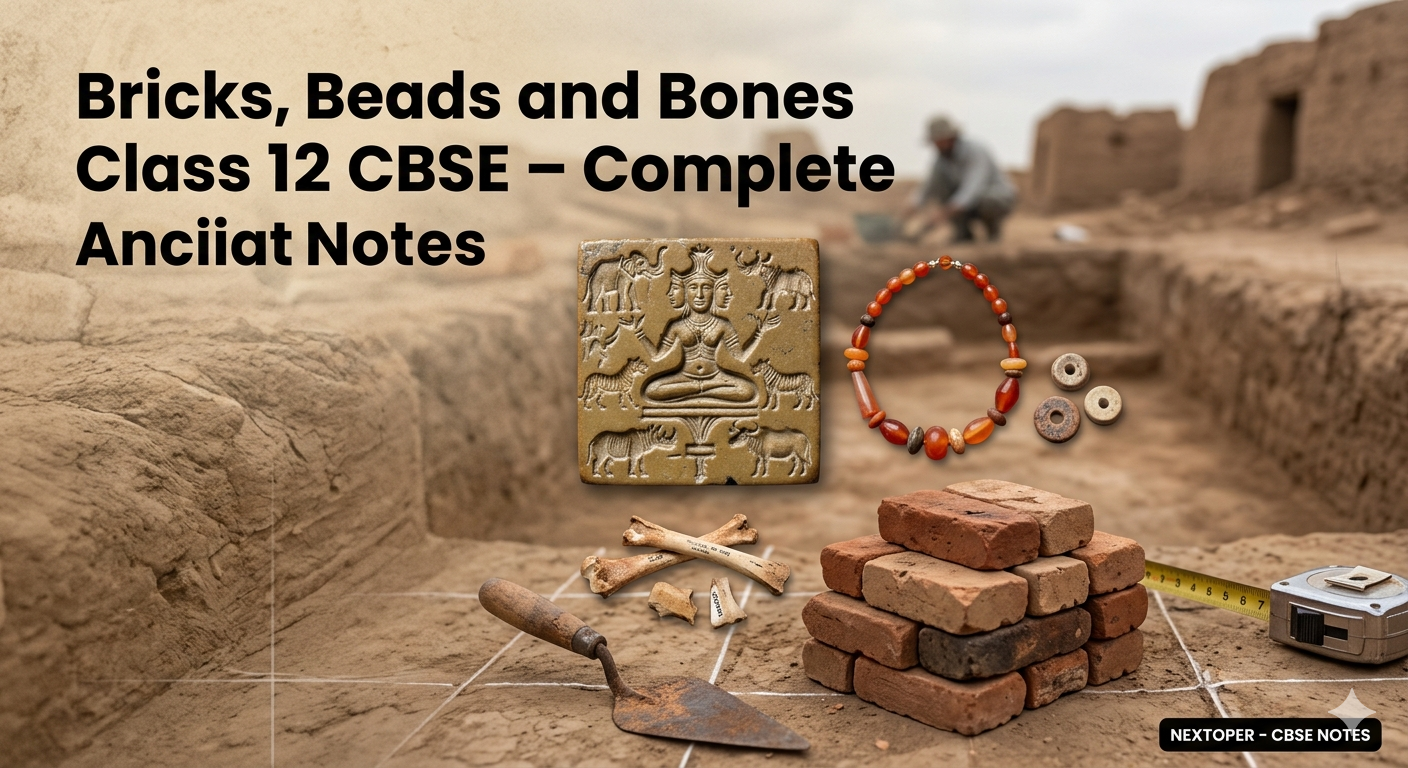
Bricks Beads and Bones Class 12 CBSE – Complete Notes with 10 Must-Know Concepts & Important Questions
| Field | Detail |
|---|---|
| Chapter | 1 – Bricks, Beads and Bones |
| Subject | History (Themes in Indian History Part I) |
| Class | 12 |
| Board | CBSE |
| Exam Weightage | Check latest CBSE syllabus |
Bricks Beads and Bones Class 12 CBSE is the opening chapter of your History textbook, and it introduces you to one of the oldest and most fascinating urban civilisations the world has ever known — the Harappan Civilisation, also called the Indus Valley Civilisation. This chapter is not just about ancient history; it is about how archaeologists piece together the story of a civilisation from physical remains alone, without being able to read its script. That detective-work angle makes it genuinely interesting, and it also makes it one of the most frequently tested chapters in the Class 12 board exam.
These notes are organised to take you through everything the chapter covers: the discovery of Harappa, city planning and architecture, social and economic life, religious practices, the script and seals, and the theories about why this remarkable civilisation eventually declined. You will also find character sketches of key archaeologists, word meanings, and five model board-exam answers ready for revision.
Here is a useful way to approach this chapter before your exam: think of yourself as an archaeologist. Every piece of evidence discussed — a grain store, a drainage system, a bronze figurine — is a clue about how people lived. Students who ask “what does this tell us?” about each piece of evidence write far stronger History answers than those who simply memorise facts.
Table of Contents
- Discovery of the Harappan Civilisation
- Bricks Beads and Bones Class 12 CBSE – City Planning and Architecture
- Economy and Subsistence in the Harappan Civilisation
- Social Life and Craft Production
- Religious Beliefs in the Harappan Civilisation
- The Harappan Script and Seals
- Key Archaeologists – Cunningham, Marshall, and Wheeler
- Decline of the Harappan Civilisation
- Important Questions – Bricks Beads and Bones Class 12 CBSE
- Quick Revision – 10 Key Points to Remember
- Related Notes on Nextoper – Internal Links
- Useful External Resources – Outbound Links
Discovery of the Harappan Civilisation
The story of how the Harappan Civilisation came to light is itself remarkable. In 1856, workers laying a railway line between Karachi and Lahore stumbled upon unusual brickwork while digging. Not realising the significance of what they had found, they used the ancient burnt bricks as ballast for the railway track — unknowingly destroying part of a 4,000-year-old urban site.
The formal discovery came much later. In 1921–22, archaeologist Daya Ram Sahni excavated a site called Harappa, located in present-day Pakistan. Around the same time, Rakhaldas Banerjee was excavating Mohenjodaro — a site on the right bank of the Indus River in the Sindh region. In 1924, Sir John Marshall, then Director General of the Archaeological Survey of India, announced the discovery of an entirely new ancient civilisation to the world through the journal Illustrated London News. He called it the Indus Valley Civilisation.
The civilisation is dated from approximately 2600 BCE to 1900 BCE. It is also called the Harappan Civilisation because Harappa was the first site to be excavated and formally identified.
Major Sites of the Harappan Civilisation
The civilisation was spread across a vast geographical area. Key sites include:
- Harappa and Mohenjodaro — the two most famous centres (both in present-day Pakistan)
- Dholavira and Lothal — in Gujarat, India
- Kalibangan — in Rajasthan, India
- Banawali and Rakhigarhi — in Haryana, India
- Chanhudaro and Kot Diji — in Pakistan
[Image: Map of the Indian subcontinent showing the spread of major Harappan sites | Alt text: Bricks Beads and Bones Class 12 CBSE – map of Harappan civilisation sites]
Bricks Beads and Bones Class 12 CBSE – City Planning and Architecture
One of the most striking features of the Harappan Civilisation is its remarkably planned urban layout — a level of civic organisation that was unusual for its time anywhere in the ancient world.
The Two-Part City
Most major Harappan cities were divided into two distinct sections. A smaller, elevated section — called the citadel — sat on a raised platform and contained large public structures. Below it lay the lower city, which was larger and housed the residential areas. This separation suggests the existence of some form of governance or social hierarchy, though historians disagree about its exact nature.
Roads and Drainage
Streets in Harappan cities were laid out in a grid pattern — roads running roughly at right angles to each other, which is a sign of deliberate prior planning rather than organic growth. Houses were built along these streets, with their main entrances typically facing side lanes rather than the primary road, which would have reduced noise and traffic disturbance.
The drainage system of the Harappan cities is perhaps their most celebrated achievement. Every house was connected to a network of covered drains running alongside the streets. These drains were built from burnt bricks set in mortar and could be removed for cleaning. Inspection holes were placed at intervals in longer drains to allow maintenance access. This level of sanitation infrastructure was not matched in many parts of the world for thousands of years afterward.
The Great Bath
Among the most famous structures found at Mohenjodaro is the Great Bath — a large, watertight tank measuring approximately 11.88 metres long, 7.01 metres wide, and 2.43 metres deep. It was constructed from burnt brick and waterproofed using a tar-like substance. Staircases led down into the water from both ends, and rooms surrounded the structure on multiple sides.
Scholars believe the Great Bath was used for ritual purification rather than ordinary bathing — a practice that connects to later Hindu traditions of sacred bathing. Archaeologist Ernest Mackay suggested it may have been used by priests.
Granaries and Public Buildings
At Harappa, archaeologists discovered rows of large granaries near the river. Their main openings faced the waterway, suggesting that grain and other goods arrived by boat and were stored directly. A large assembly hall with twenty pillars was found at Mohenjodaro — believed to have been used for public gatherings, religious events, or administrative meetings.
Economy and Subsistence in the Harappan Civilisation
The Harappan people supported themselves through a combination of agriculture, animal husbandry, craft production, and long-distance trade — a diverse economy that was more sophisticated than many people assume.
Agriculture and Food
Crops grown included wheat, barley, pulses, sesame, and mustard. Evidence of rice has been found, though it was less common. Millet grains have been found specifically at Gujarat sites. The Harappans domesticated animals including cattle, sheep, goats, buffalo, and pigs. Bones of deer and crocodile suggest that hunting also contributed to their diet.
Fields were ploughed using bullocks. Clay models of ploughs have been discovered at Banawali in Haryana and at sites in Cholistan. Irrigation was carried out using wells, ponds, canals, and river water — and at Dholavira, a sophisticated system of water reservoirs has been found.
Craft Production and Trade
The Harappans were skilled craft producers. Beads — one of the central topics of this chapter — were made from a wide range of materials: carnelian, jasper, quartz, alabaster, copper, bronze, gold, shell, and clay. Different materials required different techniques; for example, soft stones like steatite (soapstone) could be shaped more easily, while harder stones required specialist tools.
Seals — small square or rectangular objects usually made of steatite — were one of the most distinctive Harappan artefacts. They were used to identify goods in trade, confirm ownership, and possibly as amulets. Seals from Harappan sites have been found as far afield as Mesopotamia (modern Iraq), confirming active long-distance trade. Harappan goods also reached Bahrain, Iran, and Afghanistan.
Weights and measures were standardised across the civilisation — a remarkable achievement. Stone weights followed a binary system (1, 2, 4, 8, 16, 32…), and were made from a stone called chert in cuboid shapes. This consistency across hundreds of kilometres of territory implies some form of centralised regulation of trade.
[Image: Harappan seals with pictographic inscriptions and animal motifs | Alt text: Bricks Beads and Bones Class 12 CBSE – Harappan seals and script]
Social Life and Craft Production
Social Organisation
Historian V. Gordon Childe suggested a four-part social structure: an educated class (priests, physicians, astrologers), warriors or soldiers, traders and artisans (weavers, potters, goldsmiths), and workers and farmers (basket makers, fishermen). Evidence from burials supports the idea of social differentiation — some graves contained jewellery and copper mirrors, while others were plainer.
Luxury items serve as useful markers of social status. Small vessels made of faience (a glassy material made from silica paste) were found at Mohenjodaro, Harappa, and Kalibangan — but not at smaller settlements, suggesting they were available only to wealthier members of society. Gold ornaments were similarly rare and high-value.
Clothing and Ornaments
Men wore dhoti-style lower garments and upper wraps; women wore garments similar to a saree or ghagra. Both men and women wore ornaments — rings, earrings, bangles, necklaces, and armbands. Wealthier individuals used gold and silver; others used copper, bronze, and bone. A spindle whorl found in the excavations confirms that spinning and weaving were practised.
Burial Practices
Sir John Marshall identified three types of burial in Harappan sites: complete burial (the whole body interred in a pit), partial burial (remains after exposure to animals or birds), and cremation followed by burial of ashes in a vessel. The largest cemetery found is at Harappa, designated R-37. At Lothal, a pair burial — one male and one female — has been interpreted as possible evidence of the practice of sati, though this remains debated.
Religious Beliefs in the Harappan Civilisation
The Harappans left no temples — at least none that archaeologists have positively identified. Their religious life must be inferred from figurines, seals, and symbols.
Goddess worship appears significant: large numbers of clay female figurines have been found across Harappan sites, and many seals depict female figures. Historian R.S. Tripathi suggested that the Mother Goddess held the highest religious status in this culture.
A famous seal from Mohenjodaro — sometimes called the Pashupati seal — shows a seated, three-faced male figure surrounded by animals including a buffalo, jackal, elephant, and rhinoceros. Many scholars identify this figure as a proto-Shiva or Lord of Animals (Pashupati), though this interpretation is not universally accepted.
Tree worship and animal worship are also evidenced by seals depicting peepal trees and bulls. Linga worship is suggested by the discovery of stone objects resembling lingas. The swastika symbol appears on Harappan seals and has been considered a sacred symbol since ancient times.
The Harappan Script and Seals
The Harappan script remains one of the great unsolved mysteries of ancient history. It is a pictographic script — meaning it uses pictures and symbols to represent words or sounds. The script is written from right to left and is sometimes written alternately right-to-left and left-to-right (a style called Boustrophedon). The number of symbols ranges from approximately 375 to 400.
The first attempt to read the script was made by Wendell in 1925. More recent attempts have been made by scholars including Natwar Jha and Rajaram — but the script has not been definitively deciphered to date. The largest single inscription was found at Dholavira, displayed on what archaeologists believe was a signboard.
Seals served multiple purposes. They identified the sender of goods in trade transactions. If a seal was found unbroken on a parcel, it confirmed the package had not been tampered with. Most seals are square, made from steatite, and carry both a pictographic inscription and an animal motif — bulls and unicorn-like figures are among the most common.
Key Archaeologists – Cunningham, Marshall, and Wheeler
Alexander Cunningham
Alexander Cunningham was the first Director General of the Archaeological Survey of India, often called the father of Indian archaeology. He began systematic excavations in the mid-nineteenth century. When a Harappan seal was shown to him, he failed to recognise its significance — he assumed it belonged to the early historical period associated with Gangetic cities, not realising the seal was far older than any civilisation he was aware of. This error is now used in the chapter to illustrate the limits of relying too heavily on preconceived frameworks when reading archaeological evidence.
Sir John Marshall
Marshall officially announced the discovery of the Harappan Civilisation in 1924 and gave it its name. He oversaw systematic excavations at both Harappa and Mohenjodaro and produced detailed reports that became the foundation for all subsequent scholarship on the civilisation.
R.E.M. Wheeler
Mortimer Wheeler became Director General of the Archaeological Survey of India in 1944. He brought greater scientific rigour to excavation methodology, including the use of stratified digging — carefully documenting which layer of soil each artefact was found in, which helps establish relative dating.
Important Questions – Bricks Beads and Bones Class 12 CBSE
Q1. What is the other name of the Harappan Civilisation and why? (1 Mark) The Harappan Civilisation is also called the Indus Valley Civilisation because it developed along the Indus River valley and its surrounding regions in present-day Pakistan and northwest India.
Q2. Describe the drainage system of the Harappan cities. What does it tell us about Harappan society? (3 Marks) The drainage system of Harappan cities was one of the most advanced of the ancient world. Every house was connected to covered street drains made of burnt bricks set in mortar. These drains could be removed for cleaning, and inspection pits were placed at intervals in longer drains to allow solid waste to accumulate separately from liquid waste. The system was city-wide and carefully maintained. This tells us that the Harappans had a strong sense of public hygiene and civic responsibility, and that some form of municipal authority must have existed to plan, build, and maintain such infrastructure across an entire city.
Q3. What were Harappan seals used for, and what information do they provide about the civilisation? (3 Marks) Harappan seals were small objects — usually square, made of steatite — bearing a pictographic inscription and an animal motif. They were used primarily in trade to identify the sender of goods and to verify that parcels had not been opened in transit. Their discovery at sites across Mesopotamia, Bahrain, and Persia confirms that the Harappans engaged in long-distance trade with multiple civilisations. The animal motifs — including bulls, elephants, and the mysterious “unicorn” — provide clues about animals that were culturally significant to the Harappans. The undeciphered script on the seals remains one of the most significant unresolved questions in ancient history.
Q4. Explain the layout and main features of a typical Harappan city. (5 Marks) Harappan cities were planned with a precision and sophistication that sets them apart from most other ancient urban centres. A typical city was divided into two parts: an elevated citadel in the upper section, and a larger lower city below. The citadel contained major public structures — including, at Mohenjodaro, the Great Bath and what appears to have been an assembly hall — while the lower city housed residential areas. Streets were laid out in a near-perfect grid pattern, cutting across each other at right angles. Houses were built from standardised burnt bricks (in a ratio of 4:2:1 — length to width to height) and typically had their entrances facing side lanes rather than main roads. Most homes contained multiple rooms, bathrooms, and wells. The drainage system was city-wide and covered — dirty water from individual houses flowed into street drains, which then carried it out of the city. The Great Bath at Mohenjodaro, measuring nearly 12 metres long and over 2 metres deep, was waterproofed with bitumen and surrounded by rooms — likely used for ritual bathing by priests or community leaders. Granaries found at Harappa were positioned near the river with their openings facing the water, suggesting that goods arrived by boat. Taken together, these features point to a society with strong civic governance, standardised construction practices, and a high priority placed on public health and order.
Q5. Discuss the theories put forward by historians and archaeologists to explain the decline of the Harappan Civilisation. (5 Marks) The Harappan Civilisation began to decline around 1900 BCE, and historians have proposed several explanations, none of which is universally accepted. The first theory points to natural disasters — particularly severe floods in the Indus River system. Archaeological evidence of thick layers of silt at Mohenjodaro supports the idea that the city experienced repeated flooding, which may have made continued habitation unsustainable. A second theory proposes tectonic activity — earthquakes powerful enough to alter river courses and damage city infrastructure. A third explanation focuses on climate change and drought: research suggests that the region experienced a prolonged dry period around 2000 BCE, which would have severely disrupted agriculture and forced populations to migrate. A fourth theory, associated with earlier scholars like Mortimer Wheeler, attributed the decline to Aryan invasions — the idea that incoming Indo-Aryan peoples militarily defeated the Harappans. However, this theory has been largely discredited by modern archaeologists, who point out that the decline was gradual rather than sudden and that the evidence for violent conquest is thin. Most contemporary historians favour a multi-causal explanation — a combination of environmental stress, shifting river courses, and declining trade networks — that made the large urban centres impossible to sustain over time. The population did not disappear; rather, people moved eastward and southward, and smaller settlements continued for centuries after the major cities were abandoned.
Quick Revision – 10 Key Points to Remember
- Bricks Beads and Bones Class 12 CBSE introduces the Harappan Civilisation, one of the world’s earliest urban civilisations, dated from approximately 2600 BCE to 1900 BCE.
- The civilisation was discovered formally in 1921–22, with Daya Ram Sahni excavating Harappa and Rakhaldas Banerjee excavating Mohenjodaro; Sir John Marshall announced the discovery to the world in 1924.
- Harappan cities were planned in a grid layout with a two-part structure — a raised citadel containing public buildings and a lower city for residential use.
- The Great Bath at Mohenjodaro is one of the most famous ancient structures, believed to have been used for ritual purification; it is waterproofed with bitumen and surrounded by rooms.
- The drainage system of Harappan cities — covered, brick-lined, and maintained through inspection pits — was among the most advanced of any ancient civilisation and indicates strong civic governance.
- Standardised weights (following a binary system) and burnt bricks (in a 4:2:1 ratio) found across hundreds of sites suggest a high degree of centralised regulation and shared urban culture.
- Seals — mainly square steatite objects with pictographic inscriptions and animal motifs — were used in trade; their discovery in Mesopotamia confirms the Harappans traded internationally.
- The Harappan script is pictographic and written right to left (and sometimes Boustrophedon); it has not been deciphered despite numerous attempts since 1925.
- Social stratification is evidenced by burial practices and luxury goods: richer graves contained jewellery and copper mirrors; faience vessels and gold ornaments were found only at large sites, not small settlements.
- The civilisation’s decline (around 1900 BCE) is attributed to a combination of factors including floods, climate change, and shifting river courses — the Aryan invasion theory is no longer widely accepted by scholars.
Related Notes on Nextoper
Explore these related CBSE notes on Nextoper to strengthen your preparation:
- If you prefer studying in Hindi, check out our Hindi medium version of these notes: Hindi version
Prepared by the Nextoper Editorial Team | Based on NCERT Class 9 English Beehive | For CBSE Board Exam Preparation


Pingback: Class 12 History Notes Chapter 1 Bricks, Beads and Bones in Hindi — Complete Harappan Civilisation Summary, Notes, NCERT Solutions & Study Material - Nextoper
Pingback: Class 12th History Chapter 7 Part 2– Vijayanagara Notes
Pingback: Class 12th History Chapter 10 Notes in English - Colonialism and the Countryside Complete Summary, Notes & NCERT Solutions - Nextoper
Pingback: Class 12 Political Science The End of Bipolarity Notes Handwritten-Style | Nextoper Notes - Nextoper
Pingback: Kings Farmers and Towns Class 12 CBSE – Complete Notes with 10 Must-Know Concepts | Nextoper - Nextoper
Pingback: CBSE Class 12 Kinship Caste and Class – Complete Notes with 10 Must-Know Concepts | Nextoper - Nextoper
Pingback: Class 12 Thinkers Beliefs and Buildings – Free Complete Notes | Nextoper
Pingback: Class 12 CBSE Through the Eyes of Travellers – Free Complete PDF Notes | Nextoper Notes - Nextoper